Have you created an email campaign and not gotten the expected results? This article is for you!
In 2026, email marketing remains the most profitable digital channel, generating an average return of 42 dollars for every dollar invested, according to Digital Applied. (2026). Email Marketing Statistics 2026: 200+ Essential Data. Yet, many companies frustratingly find that their campaigns struggle to convert subscribers into customers. If your open rates are stagnating and your clicks are not translating into sales, the problem does not stem from the channel itself, but from its execution.
The ecosystem of’e-mailing has profoundly changed. Spam filters have become unforgiving, artificial intelligence has redefined personalization standards, and mobile reading habits demand absolute conciseness. In this article, we dissect the main causes dragging down your conversion rates and provide you with precise fixes to transform your database into a true growth engine.
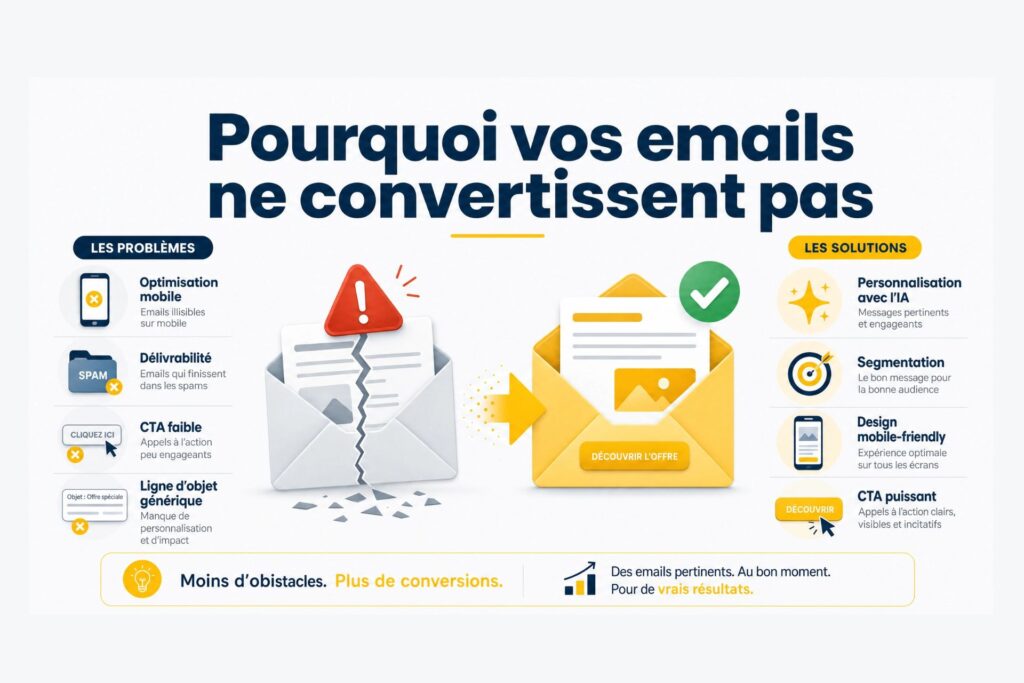
The diagnosis: why your emails are failing
Before rethinking your content strategy, it is imperative to check the technical and structural foundations of your campaigns. A brilliantly written email will never convert if it doesn't reach the primary inbox or if it is unreadable on a smartphone.
The deliverability wall in 2026
The number one reason for non-conversion is often invisible: your emails simply aren’t reaching their destination. Since the first quarter of 2024, Google and Yahoo have enforced strict authentication rules (DMARC, SPF, DKIM) that have permanently changed the game. In 2026, it’s estimated that nearly 17 % of legitimate business emails fail due to faulty DNS configurations, as mentioned here: Mailbird. (2026). Why Emails Fail: 2026 DNS Crisis.
If your domain is not properly authenticated, your campaigns will systematically land in the spam folder, reducing your conversion rate to zero. The solution is to perform a complete technical audit of your sending infrastructure. Make sure your SPF and DKIM protocols are valid and your DMARC policy is set to «p=quarantine» or «p=reject». At Flowr Agency, this deliverability audit is the first step in taking back control of any emailing strategy.
The pitfall of mobile optimization
Today, more than 55 % of emails are opened on mobile devices, according to Maropost. (2026). 5 Tips for higher email marketing conversion rates in 2026. If your design is not thought out «mobile-first,» you instantly lose more than half of your conversion opportunities. An unoptimized email translates to tiny fonts, images that overflow the screen, and call-to-action (CTA) buttons that are impossible to click with a thumb.
To fix this issue, adopt a single-column layout. Use large font sizes (at least 16px for body text and 22px for headings) and make sure your CTA buttons measure at least 44x44 pixels to be easily clickable. Finally, limit the total weight of your email to under 1 MB to ensure instant loading, even on slow mobile connections.
Copywriting mistakes that kill your email campaign conversion
Once the technical hurdles have been cleared, your content must do the convincing. Writing errors are often subtle, but they have a devastating impact on your readers' engagement and the email ROI of your email campaigns.
Predictable and ignored email subject lines
Your email subject line is the only barrier between your message and the trash. In any high-performing email campaign, generic, oversold, or purely descriptive subject lines no longer work. Users are inundated with pitches and ruthlessly filter their inboxes, which directly impacts your email open rate.
Recent data shows that counterintuitive approaches yield the best results in email marketing in 2026. Using reverse psychology (for example, «This might not apply to you» or «Keep scrolling») can increase email open rates by more than 20 %. Similarly, subject lines using the «The best way to…» structure see increases of 17 to 19 %. The goal is to pique curiosity without misleading the reader about the email’s actual content.
Impersonal calls to action (CTAs)
The call-to-action button is the culmination of your email campaign. If it is weak, generic, or poorly worded, email conversion will not happen. Classic phrases like «Click here» or «Learn more» have become invisible to readers and drag down your email conversion rate.
The most effective way to improve your email campaign in 2026 is to write your CTAs in the first-person singular. By changing «Add to Cart» to «Add to my cart,» or «View the promotion» to «Reveal my discount,» you can increase your click-through rate by 20 %. This subtle psychological tweak transforms a command into an action that feels natural to the user, directly boosting your email marketing conversion rate.
The lack of relevance and personalization
Sending the same message to your entire database is a guarantee of getting mediocre conversion rates. Consumers now expect tailored experiences, aligned with their behaviors and preferences.
The lack of behavioral segmentation
If you treat a new lead the same way you treat a loyal customer of three years, your message will fall flat. Segmentation is no longer limited to demographics (age, gender, location); it must be behavioral. You need to categorize your subscribers based on their engagement level, purchase history, and position in the conversion funnel.
Set up specific automated workflows: a warm welcome sequence for new subscribers, ultra-targeted abandoned cart reminders, and reactivation campaigns for inactive subscribers. A Email marketing strategy performance relies on sending the right message to the right person at the right time.
Underexploit artificial intelligence
Artificial intelligence has revolutionized mass personalization. Companies that do not use AI to optimize their campaigns are falling severely behind the competition. Email subject lines generated and optimized by AI outperform those written by humans by 26 % in terms of open rates.
AI also makes it possible to optimize send time (Send-Time Optimization) by analyzing each subscriber's reading habits individually. Combined with dynamic content blocks that adapt in real time to user preferences, this hyper-personalization can dramatically increase revenue generated per send.
Benchmarks 2026: where do you stand?
To evaluate the effectiveness of your campaigns, it is essential to compare yourself against your industry's current standards. Here are the average open rates observed in 2026, adjusted to account for inflation caused by privacy protections (such as Apple Mail Privacy Protection):
| Industry sector | Average open rate (2026) |
|---|---|
| Government and politics | 28,77 % |
| Education | 27,31 % |
| Nonprofit organizations | 26,84 % |
| Health and medical | 24,72 % |
| Real estate | 23,67 % |
| Financial services | 23,14 % |
| Technology and SaaS | 20,47 % |
| Retail and e-commerce | 15,68 % |
| Overall average (all sectors) | 21,33 % |
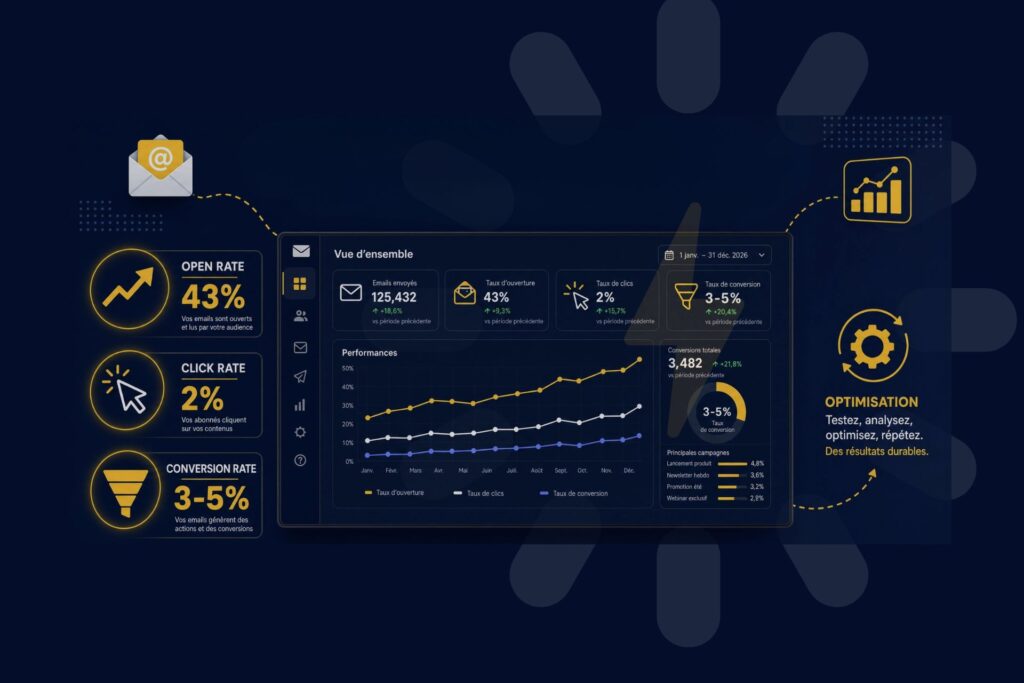
If your metrics are significantly below these averages, it’s time to audit your practices by implementing the corrective measures detailed in this article. A healthy conversion rate generally ranges from 2 % to 5 %, depending on the nature of the offer and the audience’s qualification.
Frequently asked questions (FAQ)
What is the best day to send an email campaign in 2026?
There is no longer a universal «best day.» The recommended practice in 2026 is to use AI-powered Send-Time Optimization, which analyzes each subscriber's history to deliver the email at the exact moment they are most likely to check their inbox.
Why is my open rate high but my click-through rate very low?
This discrepancy usually indicates a «message match» issue. Your email subject line was catchy enough to encourage opening, but the content of the email did not deliver on the promise of the subject line. This can also stem from a design that is not optimized for mobile or a confusing or poorly positioned call to action (CTA).
How do I know if my emails are going to spam?
A sharp drop in your open rates (below 10–12 %) is the first indicator. For an accurate diagnosis, use deliverability testing tools such as Mail-Tester or GlockApps. They will analyze your DNS configuration (SPF, DKIM, DMARC) and the content of your email to identify what is triggering spam filters.
What is the ideal length for an email subject line?
Since more than 55 % of emails are opened on mobile devices, the ideal length for a subject line is between 25 and 50 characters. Any longer, and the text may be cut off on small screens. Always place the most important words and the elements that pique curiosity right at the beginning of your subject line.
Is A/B testing really essential for every campaign?
Yes, A/B testing remains the most reliable way to improve your conversions. However, the golden rule is to test only one variable at a time (whether it's the subject line, the CTA, or the visual). If you modify several elements simultaneously, you won't know what actually influenced your subscribers' behavior.

 Français
  English