Email marketing remains in 2026 one of the most profitable acquisition and retention channels, with an average return on investment of 33 to 45 euros for every euro invested. However, many executives and marketing managers are seeing stagnation or even a drop in their performance. If you already have a qualified database but your results are struggling to take off, the problem probably does not come from your audience, but from the optimization of your Email marketing KPIs, these key performance indicators that drive the real effectiveness of your campaigns.
Understanding, analyzing, and improving open rates, click-through rates, and conversion rates is essential for transforming a simple contact list into a true growth engine. In this technical article, we will break down current industry benchmarks and provide you with concrete strategies, based on 2025 and 2026 data, to turn things around and maximize the impact of your campaigns.
Understanding email marketing benchmarks in 2026
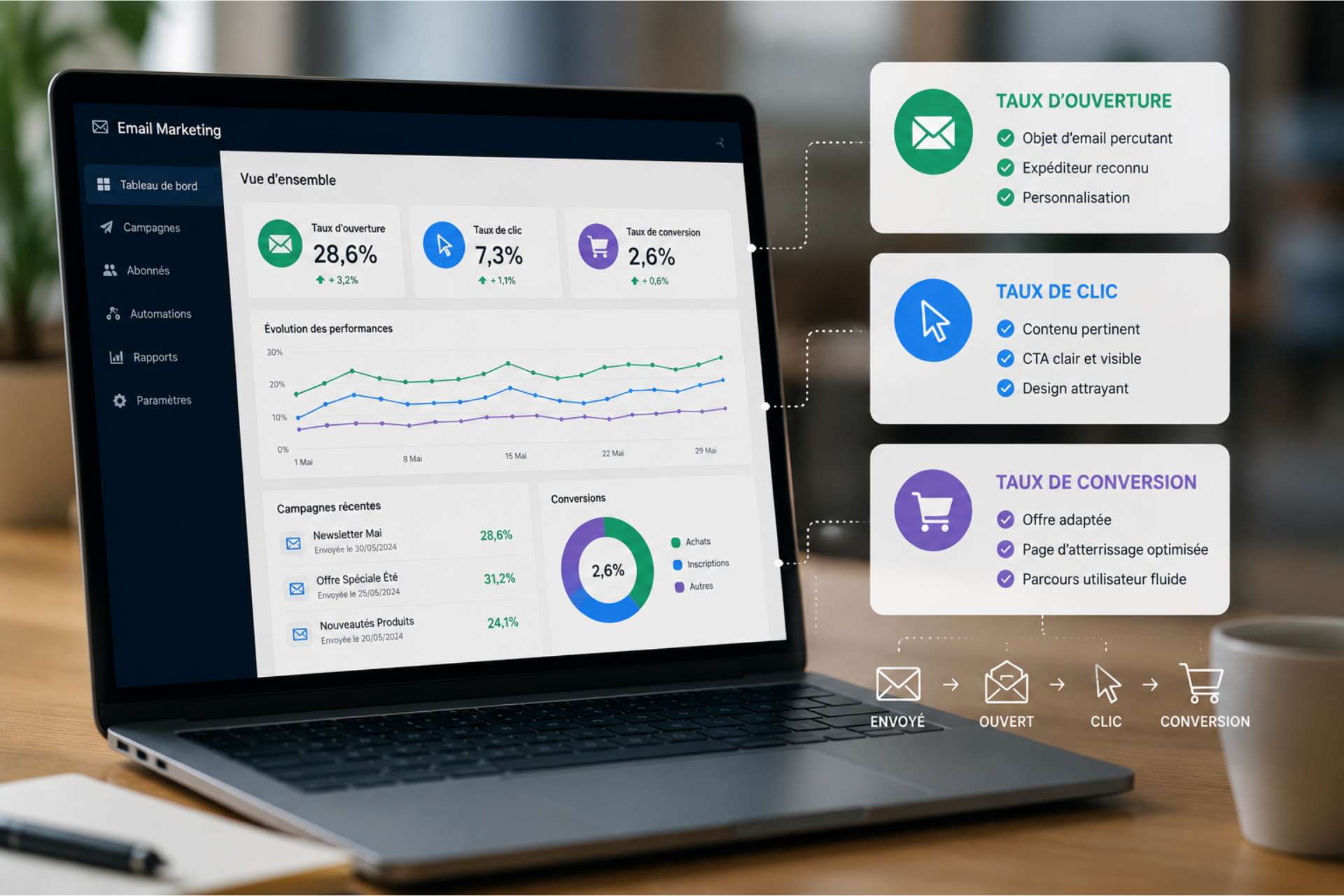
Before seeking to improve your performance, it is crucial to know where you stand relative to your market. Standards have evolved, notably with the continuous impact of privacy policies (such as Apple Mail Privacy Protection) and the growing integration of artificial intelligence in spam filters.
The open rate: the first barrier to overcome
The open rate represents the percentage of recipients who opened your email compared to the total number of emails delivered. According to recent data from MailerLite based on the analysis of 3.6 million campaigns in 2025, the overall average opening rate stood at 43.46 1Q3Q, a slight increase from the previous year.
However, this figure varies considerably by industry. For example, nonprofit organizations often reach highs of 52.38 %, while the e-commerce sector hovers around 32.67 %. The consulting and B2B services sector, meanwhile, posts a solid average of 45.96 %. It is therefore essential to compare your results with those of your specific industry rather than with an overall average.
Click-through rate and click-to-open rate (CTOR)
The email click-through rate (CTR) measures the percentage of people who clicked on at least one link in your email relative to the total number of emails delivered. The overall average currently stands at 2.09 %. Although this figure may seem low, it reflects the growing difficulty of capturing attention in crowded inboxes—a key challenge for any email marketing optimization strategy.
A metric that is often more relevant when analyzing email marketing KPIs is the email CTOR (Click-to-Open Rate). It calculates the number of clicks relative to the number of unique opens. In 2025, the average CTOR was 6.81 %, according to leading email marketing benchmarks. This metric is particularly valuable because it directly assesses the relevance of your content and the effectiveness of your call to action (CTA) among people who have actually seen your message—especially in a B2B email marketing context where qualified engagement takes precedence over volume.
The conversion rate: the ultimate goal
The conversion rate is the percentage of recipients who completed the desired action (purchase, registration, download) after clicking a link in your email. According to Unbounce and Mailchimp data, a good email conversion rate generally ranges from 2 % to 5 % across all industries.
This is where the true profitability of your strategy is at stake. An exceptional open rate is useless if your readers do not convert once they arrive on your website. The alignment between the email's promise and the experience on the landing page is the determining factor for this metric.
Advanced strategies to boost your email open rate
If your emails are not opened, the rest of your strategy is void. Email marketing open rate optimization relies on three fundamental pillars: deliverability, the email subject line, and timing.
Clean and Segment Your Database
The quality of your list takes precedence over quantity. A declining email open rate is often the symptom of an aging or poorly maintained database. The first step is to set up a cleaning routine (list scrubbing) to eliminate inactive addresses, hard bounces, and spam traps.
Next, segmentation is your best ally. Sending the same message to your entire database is a major strategic mistake in 2026. Segment your contacts based on their buying behavior, engagement level, or stated preferences. A targeted approach ensures that the content resonates with the specific expectations of each group, mechanically increasing interest and opens—it is one of the most powerful levers to improve your email performance.
Mastering the art of the subject line and preheader
The subject line is your storefront. The best practices from the 2026 email marketing benchmarks recommend conciseness: aim for a maximum of 9 words or 60 characters to ensure optimal readability on mobile devices, which now account for the majority of opens.
Avoid generic or over-promising subjects. Be descriptive and highlight the immediate benefit for the reader. The use of personalization (such as inserting a first name or company name) remains effective, but it should be used sparingly so as not to appear artificial. Don't forget to optimize the preheader (the preview text), which acts as a subtitle and offers an additional opportunity to convince the recipient to open the message.
Optimize sending timing using AI
There is no universal «best day» or «best hour» to send an email. The ideal timing depends entirely on your audience's habits. Fortunately, most modern email marketing platforms integrate AI-powered email marketing optimization features (Send Time Optimization).
These algorithms analyze each contact's engagement history to deliver the message at the exact moment they are most likely to check their inbox. Enabling this feature can generate significant gains in your email marketing KPIs without any extra effort on your part.
How to maximize click-through rate and CTOR
Once the email is open, you have a few seconds to convince the reader to take action. Optimizing the click-through rate relies on the clarity of the message, the design, and the persuasiveness of your calls to action.
Design for readability and mobile
A cluttered or non-responsive design is the fastest way to drive your readers away. Adopt a clear, spacious structure with an obvious visual hierarchy. Use short paragraphs, bullet points, and subheadings to facilitate skimming (scannability).
Mobile-First design is no longer an option. Make sure your fonts are large enough (minimum 16px for body text), your images resize properly, and your buttons are easy to tap with a thumb (minimum 44x44 pixels).
Write irresistible calls to action (CTAs)
The CTA is the tipping point of your email. Avoid passive and generic phrasing like «Click here» or «Learn more.» Favor strong, benefit-oriented action verbs formulated in the first person. For example, «Get my free guide» or «Book my consultation» systematically generate better results.
Limit the number of CTAs per email. The golden rule is «one email, one main goal.» If you offer too many options, you risk creating decision paralysis for the reader. Place your main CTA above the fold so it is visible without having to scroll, and optionally repeat it at the end of the message.
Leverage dynamic content and advanced personalization
Personalization in 2026 goes far beyond a simple «Hello [First Name]». High-performing platforms make it possible to integrate dynamic content blocks that adapt in real time based on the recipient's profile. You can thus display product recommendations based on previous purchases, or tailor the messaging to the prospect's industry sector.
This hyper-personalization creates a sense of exclusivity and relevance that significantly boosts engagement and, consequently, the click-through rate.
Turning clicks into hard cash
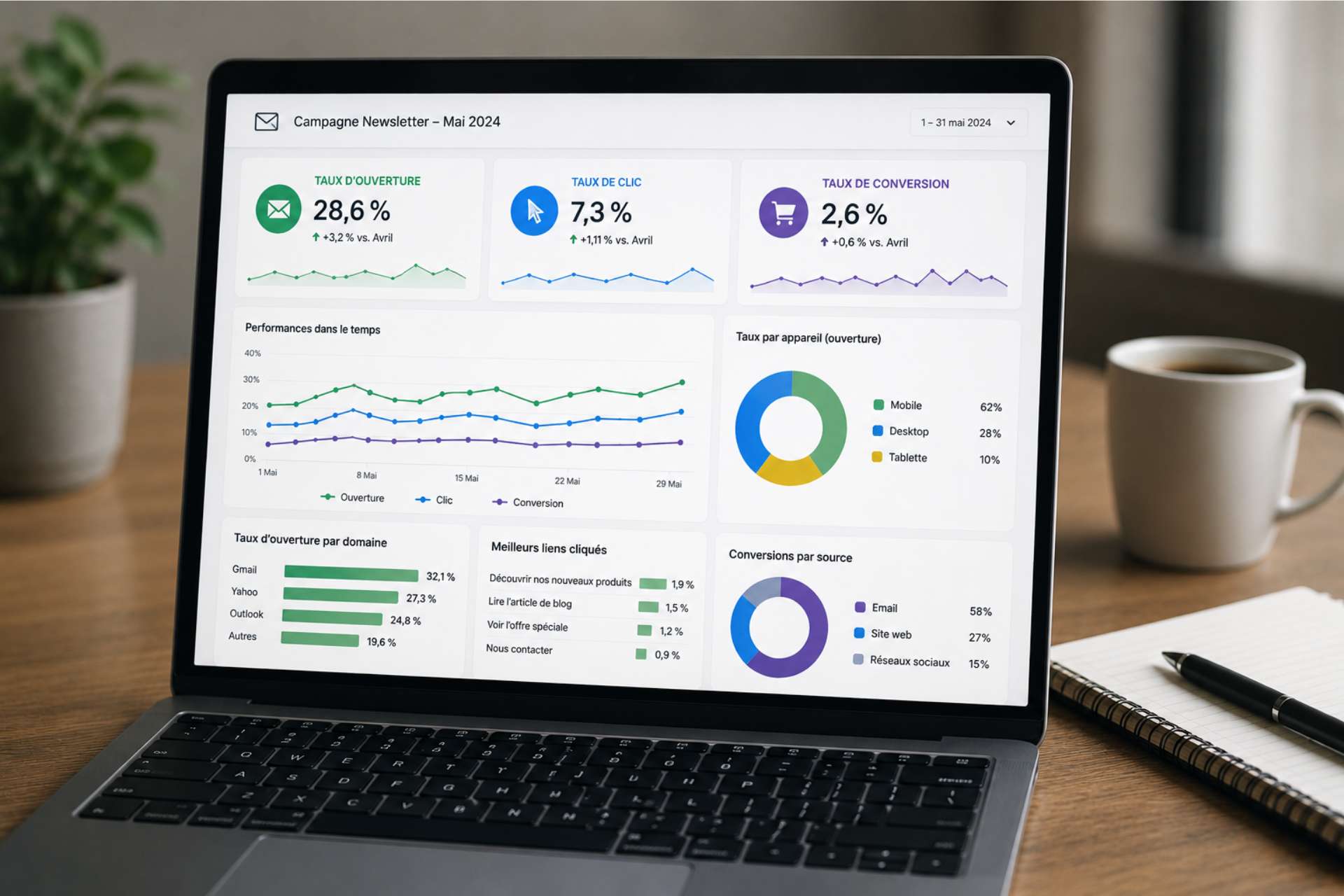
The work of email marketing doesn't stop at the click. The final email conversion rate depends on the smoothness of the user journey between the inbox and the landing page. This is truly where your email marketing KPIs are at stake.
Ensure message continuity (Message Match)
The number one cause of a low email conversion rate after a click is a lack of consistency between the email and the landing page. If your email promises a 20 % discount on a specific software product, the landing page must immediately confirm this offer, using the same language, the same visuals, and the same value proposition.
Any friction or confusion at this stage will lead to an immediate bounce. The user must understand in a fraction of a second that they are in the right place and that the email's promise will be kept, a fundamental principle of any effective email marketing optimization strategy.
Optimize the landing page for conversion
Your landing page must be designed with a single goal in mind: to finalize the action initiated in the email. Remove distracting navigation menus, reduce the number of fields in your forms to the absolute minimum, and highlight trust elements (customer testimonials, partner logos, guarantees).
Loading speed is also critical. A delay of just a few extra seconds can cut your email conversion rate in half. Make sure your pages are technically flawless and hosted on high-performance servers.
The power of continuous A/B testing
Email marketing conversion rate optimization (CRO) is not an exact science, it's an iterative process. The only way to know what really works for your audience is to test. Establish a culture of A/B test systematic approach to continuously improve your email performance.
Test one element at a time so you can isolate the cause of success or failure. You can test the email subject line to improve the email open rate, the button color or text for the email click rate, or the length of the form on the landing page for final conversion. The data collected will allow you to continually refine your approach and improve all of your email marketing KPIs.
Expert support for lasting results
Significantly improving email KPIs requires time, advanced technical expertise, and constant monitoring of algorithm changes and user behavior. If you find that your internal efforts are plateauing, it might be time to call in specialists.
At Flowr Agency, we support companies in the redesign and optimization of their Email marketing strategy. From the technical audit of your deliverability to the creation of hyper-personalized automated sequences, our data-driven approach has a single goal: to transform your database into a predictable and highly profitable acquisition channel.
Don't let your emails get lost in the limbo of inboxes anymore. By applying these optimization strategies and rigorously monitoring your KPIs, you will restore the performance your campaigns deserve.
Frequently asked questions about email marketing KPIs
What is the average email open rate in 2026?
The overall average open rate in 2025 was 43.46 %, up slightly from 2024. However, this figure varies considerably by sector: nonprofit organizations reached 52.38 %, while e-commerce stood at around 32.67 %. It is essential to compare your results with those of your specific industry rather than with an overall average.
What is a good click-through rate for an email campaign?
The overall average click-through rate (CTR) is approximately 2.09 %. A more relevant metric is the click-to-open rate (CTOR), which measures the number of clicks relative to the number of unique opens. The average CTOR in 2025 was 6.81 %. A good CTR depends on your industry and content type, but generally, a CTR between 2 % and 5 % is considered acceptable.
What is the ideal email conversion rate?
A good email conversion rate generally ranges from 2 % to 5 % across all sectors. This figure can vary significantly depending on your industry, the type of offer you provide, and the quality of your audience. The key is to track your own conversion rate over time and strive to continuously improve it through A/B testing and landing page optimization.
How to improve my email open rate?
To improve your open rate, focus on three pillars: deliverability (clean your database regularly), the email subject line (be concise, descriptive, and personalized, aiming for a maximum of 9 words), and send timing (use AI-based send time optimization). Audience segmentation is also crucial to send the right message to the right people at the right time.
Why is my email conversion rate low despite a good click-through rate?
The most common cause is a break in consistency between your email and your landing page (Message Match). If your email promises a specific offer but the destination page does not confirm it immediately, the user will bounce. Also, make sure your landing page is optimized for conversion: remove distractions, reduce the number of form fields, and highlight trust elements (testimonials, guarantees).
Are A/B tests really effective for improving email KPIs?
Yes, absolutely. Ongoing A/B testing is the key to sustainably optimizing email performance. Test only one element at a time so you can pinpoint the cause of success or failure. You can test the email subject line, the color of the CTA button, the length of the form, or even the send time. The data you collect will allow you to continually refine your approach and generate significant gains across all your KPIs.
What is the ideal frequency for sending a newsletter?
There is no universal frequency. It depends on your audience, your industry, and the quality of your content. The best approach is to test different frequencies and monitor your unsubscribe rate. If the latter increases significantly, it is a signal that you are sending too many emails. As a general rule, a weekly or bi-weekly frequency is a good starting point for most B2B companies.


 Français
  English