You've just captured a new lead thanks to your lead magnet or sign-up form. Congratulations! But what happens next? If you simply send the promised document and wait for the prospect to contact you, you're literally leaving money on the table. This is where the welcome email sequence comes in, the most powerful tool in your email marketing arsenal in 2026.
Unlike classic newsletters that often get lost in the crowd, welcome emails receive maximum attention. Your prospect has just placed their trust in you by giving you their email address. They are in an active discovery phase and expect to hear from you. Failing to capitalize on this precise moment is one of the most costly mistakes in digital marketing.
In this comprehensive guide, we'll break down the anatomy of a high-performing welcome email sequence, analyze the statistics that prove its effectiveness, and provide you with a step-by-step method for building an automation that converts your new subscribers into loyal customers from the very first days.
Why the welcome sequence is the cornerstone of your email marketing
Industry figures for 2026 are clear about the overwhelming superiority of welcome emails over all other forms of email communication. Understanding these statistics is fundamental to grasping the strategic importance of this first interaction.
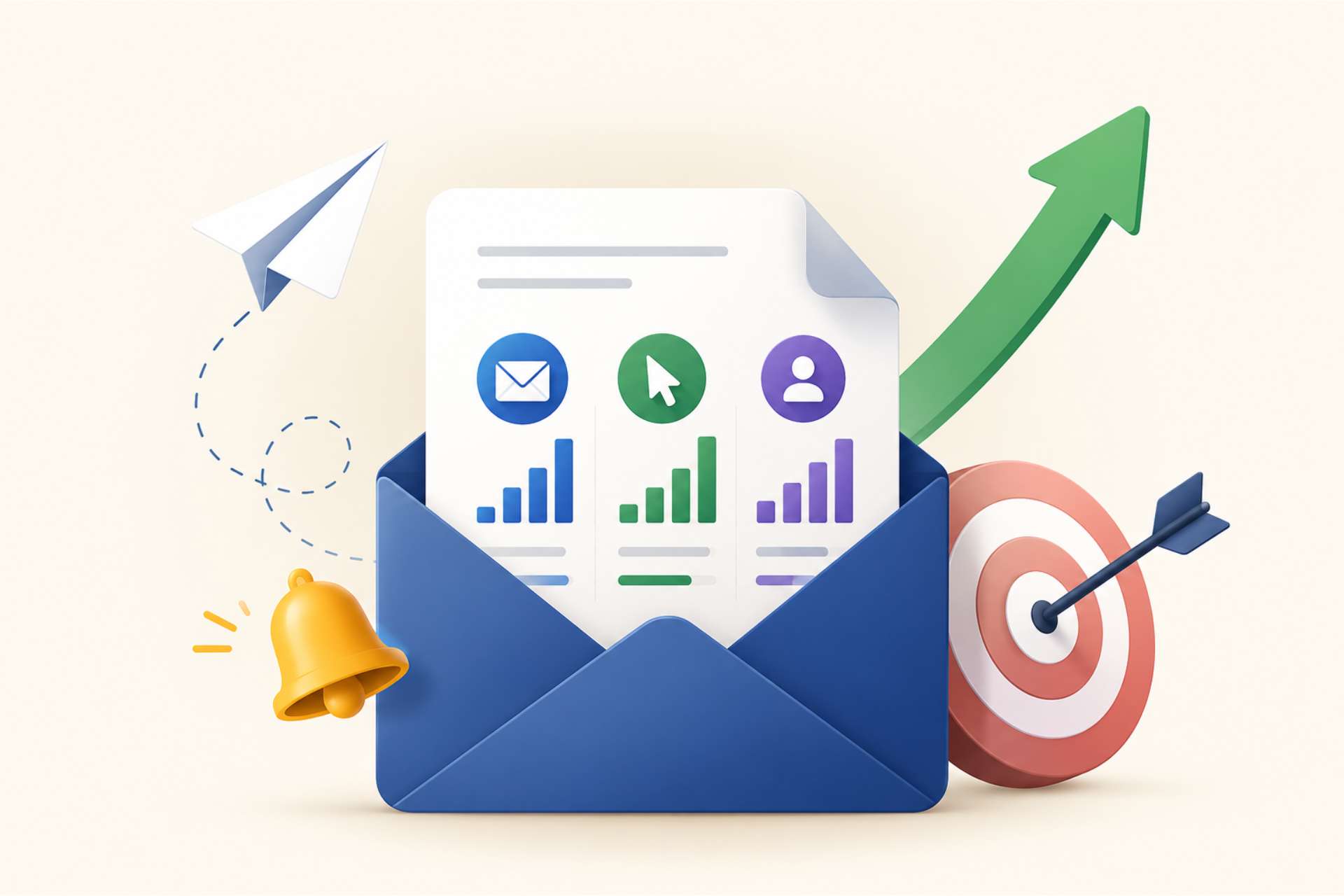
According to recent data from Mailmend, the average welcome email generates an open rate of 68.6 %, compared to just 19.7 % for standard promotional campaigns. Even more impressive, when properly automated and delivered immediately, these emails can achieve staggering open rates of 80 %. This difference can be explained by high consumer expectations: 74 % of consumers expect to receive an email immediately after signing up, according to campaign monitor.
But the open rate is only the first step. The engagement generated by these initial messages is exceptional. Click-through rates (CTR) average 26.9 %, which is nearly ten times higher than that of standard emails. In terms of return on investment, welcome sequences generate 320 % in additional revenue per email compared to standard promotional campaigns. Despite this spectacular performance, nearly 42 % of brands still fail to implement this essential automation.
The Anatomy of a Welcome Email Sequence That Converts
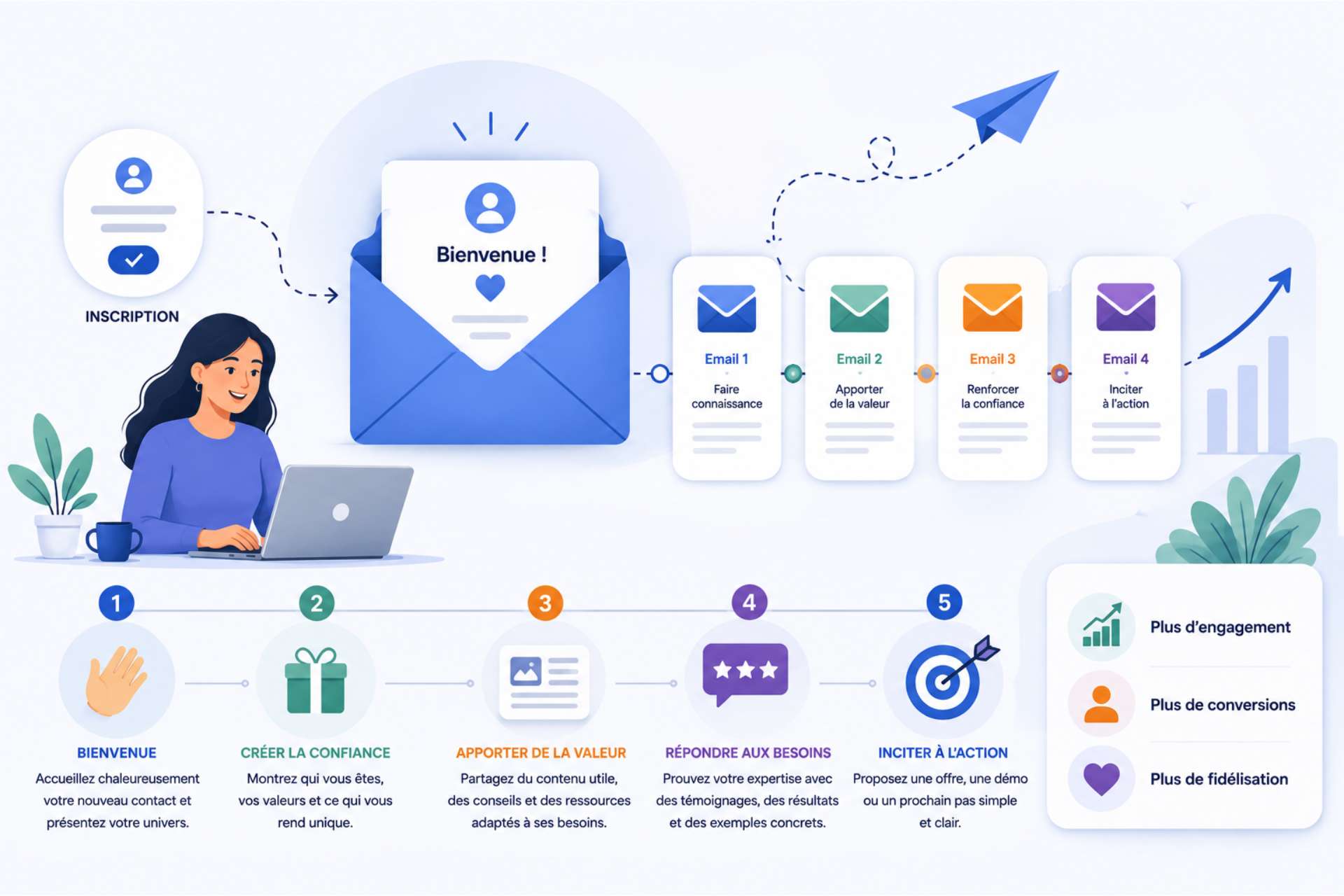
A common mistake is to think that a single welcome email A thank-you message is enough. Data shows that a multi-message welcome email sequence (typically between 4 and 6 emails) increases revenue by 51 % compared to a single message. Here is the ideal structure for a email automation sequence High-performing B2B.
Email 1: Immediate delivery and the promise
This first welcome email It should be sent within a minute of registration. Its main objective is to keep your promise (deliver the lead magnet, confirm registration) and set expectations for what comes next. It should be short, warm, and to the point.
Start by thanking the new subscriber, provide the download link prominently, then briefly explain what they will receive in the coming days. This is also the perfect time to ask them to add your address to their contacts.whitelisting) to ensure your future messages do not land in the Promotions or Spam tab.
Email 2: The Brand's Story and Emotional Connection
Sent 24 to 48 hours after the initial contact, this email from your welcome email sequence aims to humanize your company. People buy from people they trust. Tell the story of your founding, your mission, or the specific problem you set out to solve when creating your company.
Don't talk about your products aggressively yet. Focus on your values and how you help your customers. The goal is to create an emotional resonance and show that you understand the challenges your audience faces.
Email 3: The Unexpected Added Value
On the third day, surprise your subscriber by offering them extra value they didn't ask for. This could be an exclusive resource, a tutorial video, a particularly relevant blog post, or an immediately actionable tip.
This email reinforces your positioning as an expert and proves that your goal is not just to sell, but to support and educate. This is the principle of reciprocity: by giving generously in your Welcome email sequence, you increase the likelihood that the prospect will be receptive to your future offers.
Email 4: Social Proof and Case Study
Now that trust is established, it's time to demonstrate your effectiveness. The fourth email in the welcome sequence should feature a detailed case study or compelling customer testimonials. Show concretely how you helped a similar company solve the same problem your prospect is facing.
Structure this social proof around the classic framework: the initial situation (the problem), the solution provided (your intervention), and the measurable results obtained. This is where you start to bridge the gap between the prospect's need and your service offering.
Email 5: The Irresistible Offer and Call to Action
It's time for the conversion. After providing value and proving your expertise throughout your automated email sequence, you've earned the right to make a sales pitch. This email should clearly present your main offer, emphasizing benefits rather than technical features.
Integrate a strong, unique call to action (CTA). Whether it's booking a discovery call, requesting a free audit, or signing up for a trial, the desired action should be obvious. To maximize welcome email marketing conversions, you can add an element of urgency or an exclusive offer reserved for new subscribers.
Best Practices for Optimizing Your Welcome Email Sequence in 2026
To achieve the 80 % open rates and the exceptional conversion rates mentioned earlier, structure alone is not enough. Technical and strategic execution must be flawless. Here are the differentiating factors of the Welcome email sequences the best performing.
Personalization Beyond the First Name: Key to an Effective Welcome Email Sequence
In 2026, starting an email with «Hello [First Name]» will no longer be considered personalization; it will be the bare minimum. True personalization relies on behavioral and declared data. Segment your welcome email sequence based on the lead's acquisition source.
A prospect who downloaded a guide on SEO should not receive the same sequence as a prospect who participated in a webinar on social media. Adapt the content, examples, and final offer based on the initial interest shown by the subscriber. This contextual relevance is the key to maintaining engagement throughout your welcome email sequence.
Deliverability: The invisible factor that determines the success of your welcome email sequence
Even the best copywriting in the world is useless if your welcome email ends up in the Spam folder or the Promotions tab. Statistics show that engagement drops by more than 50 % when welcome emails don’t reach the main inbox.
To ensure excellent deliverability to your welcome email sequence, ensure your domain is properly authenticated (SPF, DKIM, DMARCAvoid «spammy» words in your email subjects, maintain a good text-to-image ratio, and encourage interaction from the first message (e.g., by asking a simple question and requesting a reply via email).
Plain Text vs. HTML: Which Format to Choose for Your B2B Welcome Email Sequence?
In the B2B context, the strong trend is a return to simple-looking emails, almost «plain text.» Emails overloaded with graphics, columns, and complex buttons scream «Marketing!» and often trigger messaging promotional filters.
An email from your welcome email sequence Messages that resemble personal messages sent by a colleague or partner consistently generate more trust and responses. Use HTML subtly for formatting (bold, italics, bullet points) and integrating links, but maintain a clean, conversational aesthetic.
How to measure the success of your sequence
A welcome sequence is never set in stone. It must be continuously tested and optimized. To do this, you need to track the right Key Performance Indicators (KPIs) at each stage of the funnel.
| Key Performance Indicator (KPI) | Medium Benchmark | Top Performers Objective | What that means |
|---|---|---|---|
| Open Rate (Email 1) | 50–60 % | 80–90 % | Object effectiveness and immediate deliverability |
| Click-through rate (CTR) | 10–15 % | 25–30 % | Content relevance and clarity of the call to action |
| Churn rate | < 1 % | < 0.5 % | Alignment between the initial promise and the delivered content |
| Final conversion rate | 1 – 2 % | 5 – 10 % | Sequence's ability to generate business opportunities |
If your first email has an open rate below 50 %, the problem is likely with your subject line or deliverability. If open rates are good but click-through rates are low, you need to rework your content or call to action. Systematic A/B testing (testing two different subject lines, two different CTAs) is the only reliable method for continuously improving these metrics.
Integrating with your overall strategy
The welcome sequence is only the first step in your customer relationship. Once the sequence is complete, what happens next? Subscribers who didn't convert immediately shouldn't be abandoned. They should naturally transition to your regular newsletter or a longer-term nurturing sequence.
This is where the expertise of a Specialized agency makes a difference. At Flowr Agency, we design complete ecosystems where every touchpoint is considered to move prospects through their buying journey. If you want to transform your anonymous visitors into loyal customers, discover how our expertise in email marketing agency can revolutionize your acquisition.
Conclusion
Implementing a structured and strategic welcome email sequence is one of the most profitable investments you can make for your business in 2026. This is when your prospect's attention is at its peak, their curiosity is piqued, and their trust begins to build.
By combining immediate delivery, authentic storytelling, consistent added value, and irrefutable social proof, you create an automated conversion machine that works for you 24/7. Don't let your new leads go cold anymore. Take the time to design a memorable welcome experience, and the results for your revenue will follow naturally.
Frequently asked questions (FAQ)
How many emails should an ideal welcome sequence contain?
The data shows that an optimal sequence contains between 4 and 6 emails. A single email is insufficient to build a relationship, while more than 6 close emails increase the risk of boring the subscriber and raising the unsubscribe rate.
What is the ideal delay between each email in the sequence?
The first email should be sent immediately (within the minute). Then, a spacing of 24 to 48 hours between emails 2, 3, and 4 is recommended to maintain momentum without being intrusive. The final conversion emails can be spaced 2 to 3 days apart.
Should you sell in the very first welcome email?
No, that's a major strategic error. The first email should focus exclusively on delivering the initial promise (the lead magnet) and welcoming them. The sale should only come after building trust and demonstrating your value, usually around the 4th or 5th email.
What to do with subscribers once the welcome sequence is over?
Subscribers who have completed the sequence without purchasing should be automatically switched to your main mailing list (newsletter) or to a long-term «nurturing» sequence, with a less aggressive sending frequency (weekly or bi-weekly).
 Français
  English