The majority of leaders and professionals who abandon their LinkedIn publishing strategy don't do so for a lack of ideas. They abandon it due to lack of system. Faced with the constant evolution of algorithms and the professionalization of content, publishing daily is no longer a viable strategy. In 2026, the creation of’A structured LinkedIn editorial calendar has become the cornerstone of any successful presence on this professional network.
The year 2026 marked a major turning point in how content is discovered on the platform. With the increasing integration artificial intelligence in search engines, traditional traffic has evolved considerably. According to the LinkedIn Business Blog «6 B2B Marketing Insights for 2026», B2B professionals are now 44% more likely to trust recommendations on the platform. To reach this qualified audience, it is essential to transition from a reactive approach to a proactive method, centered around a rigorous editorial calendar.

Why an editorial calendar is indispensable today
Decision fatigue is the main enemy of consistency. Asking yourself every morning «What will I publish today?» consumes precious energy and inevitably leads to inconsistency. An editorial calendar eliminates this friction by separating the strategic thinking phase from the daily execution phase. By planning ahead, you free your mind to focus on the quality of the message rather than the urgency of publication.
Beyond saving time, this planning ensures Consistency in conveyed messages. This ensures that all communication pillars of the company are addressed in a balanced way, thus avoiding the trap of exclusively promotional communication. Furthermore, it greatly facilitate collaboration within teams, allowing leaders to validate content upstream and teams to Community Management schedule posts with peace of mind.
Recent data confirms the importance of this methodical approach. Creators who plan their content maintain an optimal posting frequency, located between 3 and 5 posts per week according to Ordinal, which generates the highest engagement rates, ranging from 1.81% to 1.86%. Without a schedule, maintaining this pace over the long term is no small feat. This is the fundamental difference between a sporadic presence that goes unnoticed and an influence strategy that generates regular business opportunities.
The golden rule of content mixing: the 40-30-20-10 framework
One of the most frequent mistakes observed in B2B leadership is editorial monotony. Consistently publishing the same type of content, whether purely educational or strictly promotional, eventually tires the audience. To maintain interest and satisfy the algorithm, Variety is essential. A well-designed editorial calendar enforces this diversity by imposing a clear structure.
In 2026, the go-to framework for structuring your editorial calendar is the 40-30-20-10 rule. This distribution ensures a perfect balance between providing value, humanizing your brand, and conversion. It allows you to build brand authority while creating a close connection with your network.
| Content Type | Proportion | Concrete examples |
|---|---|---|
| Thought Leadership | 40 % | Strong opinions, methodological frameworks, lessons learned, contrarian views. |
| Industry Trends | 30 % | Reactions to current events, industry data analysis, decoding market trends. |
| Personal stories | 20 % | Behind-the-scenes of the company, storytelling, overcome failures, team victories, internal processes. |
| Promotion | 10 % | Product launch, service presentation, direct calls to action, webinar invitations. |
This 10 % cap on promotional content is strategic. LinkedIn's algorithm actively reduces the reach of posts it identifies as overtly commercial. By limiting self-promotion to one in ten posts, you protect your overall profile distribution while maintaining a dedicated space for conversion. This is the subtle difference between being perceived as an expert offering solutions and being seen as a pushy salesperson.

The essential elements of a high-performing calendar
A LinkedIn editorial calendar doesn't need to be an overly complicated system. Overly complex systems with dozens of columns and convoluted color codes are often abandoned after a few weeks. Simplicity is the key to longevity.. A simple spreadsheet or basic project management tool is more than enough to get started.
To be effective, each entry in your calendar must include at least five fundamental elements. This information is sufficient to organize production without complicating the process. It forms the backbone of your editorial organization.
First, the Date and time of publication. This allows for visualizing frequency and ensuring a regular presence. Secondly, the content format. In 2026, format diversity is crucial. Document-based posts generate an average engagement rate of 6.6%, while video has seen a 36% year-over-year increase, according to the DataSlayer Report «LinkedIn Algorithm 2026: What Works Now». Alternating between texts, carousels, polls, and videos keeps the audience's attention and fully utilizes the algorithm's capabilities.
Thirdly, the Subject and approach. It is not enough to define a general theme; the unique perspective that will be adopted must be specified. Fourthly, the content pillar, referring to the 40-30-20-10 framework, to ensure overall balance. Finally, the publication status (draft, in review, scheduled, published) to track production progress and facilitate teamwork.

Production Method: From Batching to Scheduling
Having a calendar full of ideas is an excellent first step, but you still need to transform these ideas into concrete publications. The most effective method adopted by high-performing leaders is «batching,» or batch production. This technique maximizes productivity by grouping similar tasks.
Instead of writing a post every day, block out a two-hour slot each week dedicated exclusively to content creation.. During this session, draft all the planned posts for the following week. This concentration allows you to enter a state of creative «flow,» significantly increasing the quality and speed of writing. This way, you avoid constant interruptions and procrastination.
Once the content has been written and approved, use LinkedIn's native scheduling tools or third-party platforms to schedule its distribution.. This automation ensures that your posts will go live at the best times, even when you're in a meeting or on the go. All it takes is a quick five-minute check once a week to make sure everything is in order and to respond to the first comments.

The importance of analysis and iteration
Editorial calendar is not a static document; it is a living tool which must evolve based on the results obtained. The final step of an effective strategy is to analyze performance to refine future publications. Without this feedback loop, you risk repeating the same mistakes indefinitely.
Schedule a monthly thirty-minute session to review your statistics. Identify the publications that generated the most engagement, those that sparked qualitative conversations in the comments, and those that led to direct contacts. This data will allow you to adjust your content pillars and refine your approaches for the following month. The goal is not to chase likes, but to understand what truly resonates with your target audience.
It is also crucial to integrate this approach into a more global digital strategy. Content that performs exceptionally well on LinkedIn can be repurposed to fuel your company blog or newsletter., thus creating a powerful synergy between your different communication channels. This is, moreover, the approach we favor at Flowr Agency to maximize our clients' return on investment. Good content deserves to be seen multiple times, in different formats.

The essential tools for automating your calendar in 2026
Implementing an effective editorial calendar requires relying on the right tools.. In 2026, the LinkedIn software ecosystem has significantly structured itself, clearly separating behavior automation tools (often risky for your account) from content automation tools (approved by the platform).
For pure programming and multi-network management, historical solutions like Buffer or Hootsuite remain safe bets. They offer intuitive visual calendars and allow you to plan your publications weeks in advance. However, for a strategy exclusively focused on LinkedIn, these generalist tools sometimes lack analytical depth and understanding of the professional network's specific algorithm.
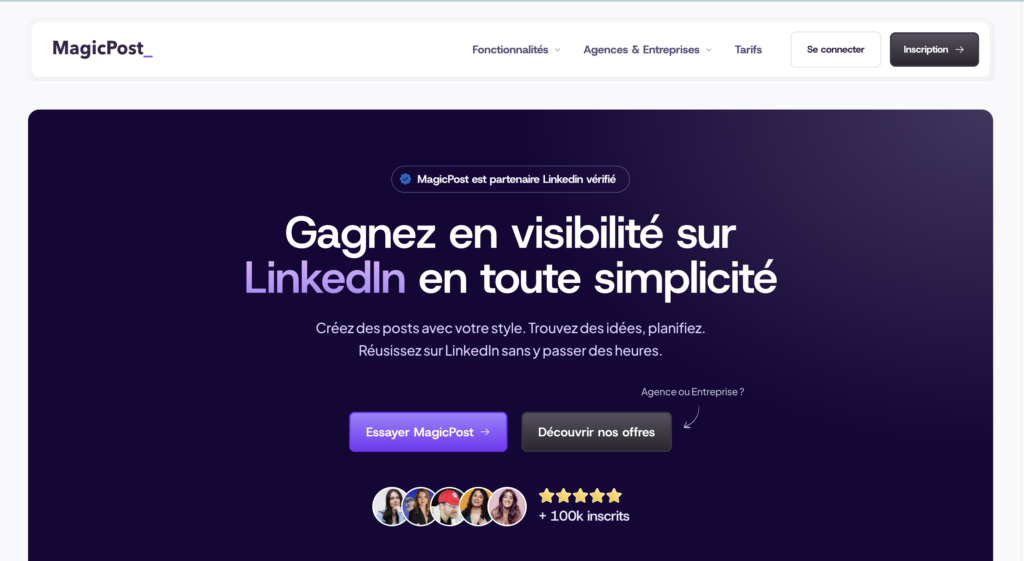
This is where specialized solutions shine. Among them, MagicPost has established itself as one of the leading tools in 2026. Designed exclusively for LinkedIn, it combines AI-powered content generation with secure automation. Unlike generic AI tools that produce standardized text, MagicPost lets you import your own writing style to maintain your authentic voice. The tool operates through LinkedIn’s official developer program with authenticated API connections, ensuring the complete security of your account.
Read also:
Magicpost: The simple AI tool to boost your visibility on LinkedIn
Using a dedicated tool like MagicPost or its alternatives (such as Supergrow or AuthoredUp) can reduce the time spent on the platform tenfold. By combining the previously described «batching» method with these next-generation tools, leaders can save up to 4 hours per week while maintaining an algorithmically perfect presence.. The goal is not to delegate your thinking entirely to a machine, but rather to use technology to eliminate the friction associated with formatting, programming, and performance analysis.

How to integrate artificial intelligence into your calendar
In 2026, ignoring artificial intelligence in managing your editorial calendar would be a strategic mistake. AI shouldn't replace your voice, but it can significantly accelerate your creation and organization process. Generative tools are excellent assistants for structuring your ideas and overcoming writer's block.
Use AI to generate lists of ideas based on your content pillars. For example, you can provide it with a recent blog post and ask it to extract three different angles for LinkedIn posts. AI can also help you Crafting impactful hooks or structuring an educational carousel. However, The final draft should always retain your personal touch and your professional expertise.
Artificial intelligence is also valuable for trend analysis.. By submitting your past publication data to it, it can identify successful patterns you might not have noticed: better performing posting days, specific formats that generate more comments, or themes that particularly attract your target audience.

How to find LinkedIn content ideas for 12 months
One of the biggest roadblocks for B2B leaders and creators isn't writing itself, but long-term idea generation. Many abandon their content calendars after a few weeks because they feel like they're «spinning their wheels.» Yet, The best LinkedIn strategies don't rely on permanent groundbreaking ideas, but on the ability to transform everyday expertise into useful and repeatable content.E.
The most effective method is to Create a content library from your actual activity. Every client meeting, business objection, internal error, feedback, or exchange with a prospect can become a publication topic. A leader who regularly documents their professional daily life actually has an almost infinite amount of potential content.
To avoid writer's block, it is recommended to structure one's ideas around several broad recurring categories :
- Frequently Asked Questions from Customers
- Common mistakes or misconceptions in the industry
- Field feedback
- Internal processes and behind-the-scenes
- Results obtained or case studies
- Personal opinions on market evolution
- Trend analysis or current events
- Tools and methods used daily
This approach allows for the creation of a sustainable editorial calendar without relying on last-minute inspiration. It also promotes much more authentic communication, because the content published is directly connected to the reality of the company and the clients' issues.
In practice, The best LinkedIn creators don't constantly look for new ideas: they reinterpret the same issues from different angles, formats, and levels of depth.. It's this intelligent repetition that builds true brand authority.

Why LinkedIn regularity directly influences your SEO and GEO visibility
LinkedIn is no longer just a professional social network. The platform has become a real content discovery engine, strongly connected to SEO logic, of GEO (Generative Engine Optimization) and AEO (Answer Engine Optimization). The Content published on LinkedIn is now being picked up, analyzed, and sometimes cited by generative search engines and conversational artificial intelligences.s.
This evolution profoundly changes how we think about a LinkedIn editorial calendar. Publishing regularly is no longer solely about keeping your audience engaged on the platform; it: also contributes to strengthening your brand's overall presence in the digital ecosystem.
Profiles and companies that frequently publish consistent content benefit from several strategic advantages:
- An increase in branded searches on Google
- A better perceived authority in their field
- More mentions in AI-generated responses
- An increase in traffic to their website
- An improvement in their business credibility
High-performing LinkedIn content also becomes a excellent raw material to feed a multichannel content strategy. A post that generates a lot of engagement can be transformed into a blog post, newsletter, YouTube video script, or even a downloadable resource.
This smart recycling logic allows for a significant increase in the return on investment for each piece of content produced. Instead of constantly creating new topics, the most successful companies today are building complete editorial ecosystems around a few strong ideas.
From this perspective, the LinkedIn editorial calendar becomes much more than a simple organizational tool: it becomes the nerve center of the company's entire digital visibility strategy.

Conclusion: Consistency trumps perfection
Creating a LinkedIn editorial calendar is no longer optional for B2B leaders who want to grow their influence and generate business opportunities. It's the indispensable system that transforms scattered ideas into a coherent and impactful professional presence. Without this framework, even the best intentions will eventually run out of steam when faced with the demands of daily entrepreneurship.
Remember that Perfection is the enemy of action. It's better to publish authentic and imperfect content three times a week than to publish an ultra-polished article once a month. The editorial calendar is the tool that will allow you to maintain this vital regularity, by smoothing out production effort over time.
If setting up and managing this system seems time-consuming to you, don't hesitate to get help. A Community management agency Saurá structure your approach, define your content pillars, and ensure regular high-quality production, allowing you to focus on your core business while reaping the rewards of an optimized LinkedIn presence.

Faq
How often should you post on LinkedIn in 2026?
Recent data shows that the optimal posting frequency is between 3 and 5 posts per week. This pace helps maintain a high engagement rate (between 1.81 and 1.86) without overwhelming the audience or burning out the content creator.
What is the 40-30-20-10 rule for LinkedIn?
It’s a content distribution framework: 40% thought leadership (expertise), 30% industry trends, 20% personal stories, and only 10% purely promotional content. This structure ensures the perfect balance for both the algorithm and the audience.
What publication formats perform best?
In 2026, carousel posts generate a very high average engagement rate of 6.6 %. Video is also experiencing strong growth (+36 % year-over-year). It is recommended to alternate these formats with traditional text posts.
How to save time when creating content?
The most effective method is «batching»: blocking out a two-hour slot each week to write all of next week's posts, then using a scheduling tool to automate their distribution at optimal times.


 Français
  English