If your business doesn’t appear among the top three results on Google Maps, you simply don’t exist for 80 % of your local prospects. By 2026, consumer behavior has changed radically: the «nearby» search has become a Pavlovian reflex that triggers in-store visits or phone calls within 24 hours. Yet the majority of small and medium-sized businesses (SMEs) settle for an incomplete Google Business Profile, allowing their competitors to capture all the qualified traffic in their catchment area.
Today, nearly 46 % of Google searches have a clear local intent. Local visibility no longer depends on chance, but on a precise mastery of local SEO. This reference guide breaks down the specific mechanisms of local SEO for 2026. From advanced optimization of your business listing to review strategies, including technical markup and local authority, you’ll learn how to dominate the famous «Local Pack» to turn every local search into an actual customer.
Understanding Google's Local Algorithm in 2026
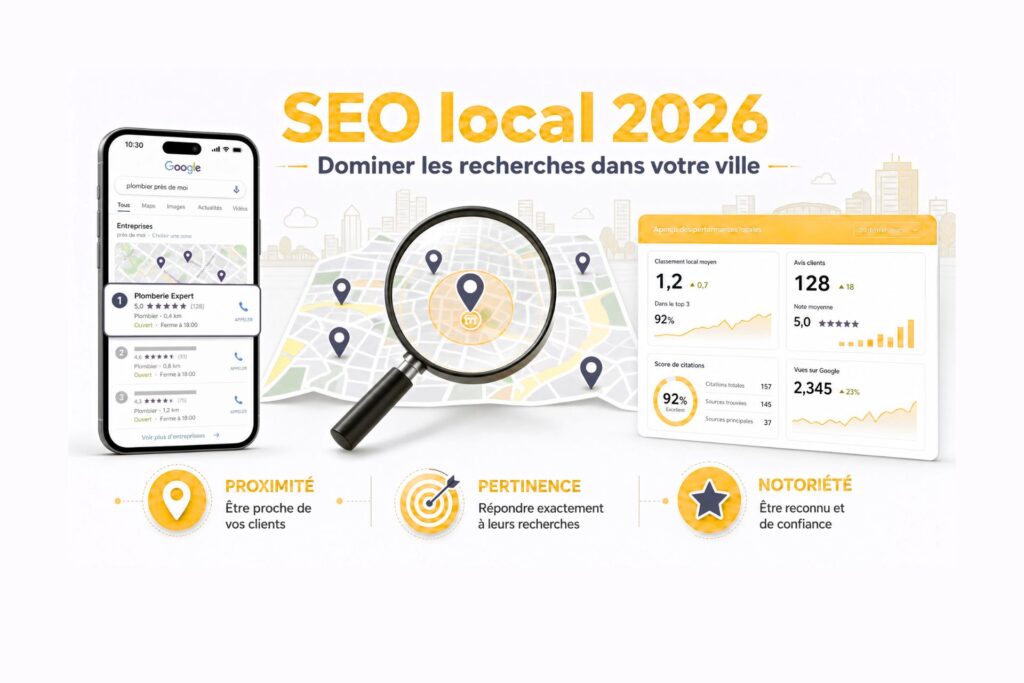
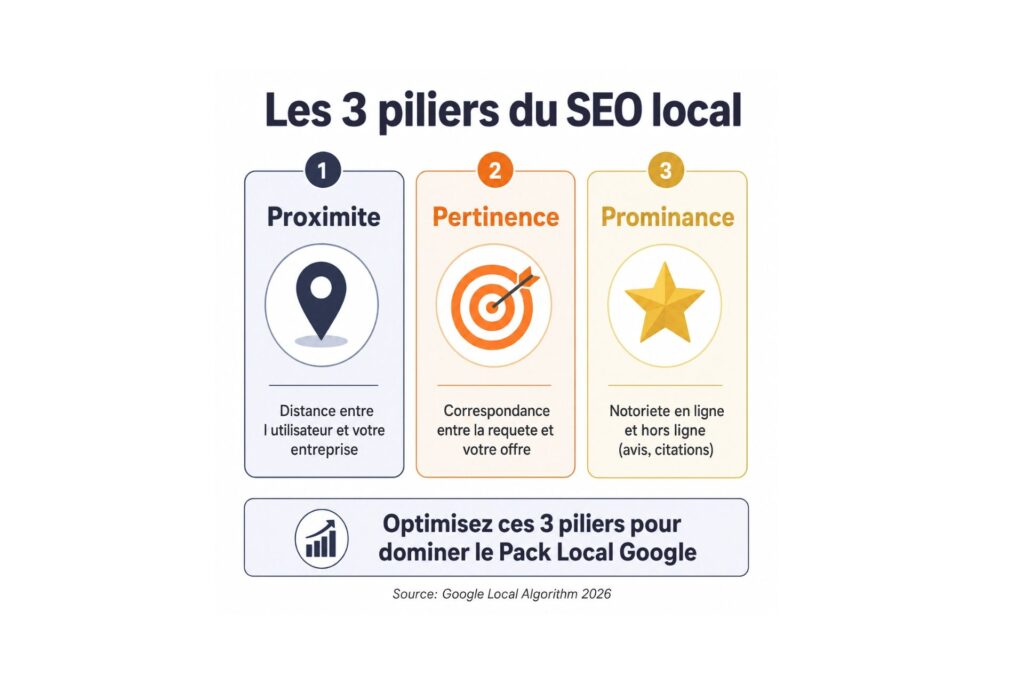
To dominate local search results, it's imperative to understand how Google decides to rank businesses. Google's local algorithm rests on three fundamental pillars that constantly interact to provide the most relevant result to the user.
1. Proximity: the geographical factor
Proximity evaluates the distance between the user performing the search and your business's location. With constant improvements in mobile geolocation, Google is capable of providing extremely accurate results. If a user searches for a «plumber» without specifying a city, Google will use their exact GPS position to suggest the closest professionals. Although you cannot change your business's physical location, you can optimize your service area to capture searches in surrounding neighborhoods.
2. Relevance: Semantic matching
Relevance measures how well your business profile matches what a user is looking for. This is where semantic optimization comes into play. If a web user searches for «Neapolitan pizzeria with a terrace,» Google will analyze the categories on your listing, your service descriptions, the content of your website, and even the text in reviews left by your customers to determine if you are the best result for that specific query.
3. Prominence: Authority and Reputation
Prominence reflects your company's notoriety in both the physical and digital worlds. Google evaluates this criterion by analyzing the volume and quality of your customer reviews, the number of links pointing to your website (local backlinks), and the consistency of your information across the web (citations). A locally well-known business with excellent reviews and a strong presence in the regional press will have high prominence.
Google Business Profile: The Cornerstone of Your Strategy
The card Google Business Profile (formerly Google My Business) is your number one local visibility lever. By 2026, it should no longer be seen as a simple directory, but as a truly dynamic and interactive showcase, often enhanced by artificial intelligence.
Advanced Configuration: Beyond the Basics
Choosing your primary category is the most impactful decision for your local SEO. It defines the semantic universe in which Google will rank you. Don't settle for an approximation: be surgical. Then, add relevant secondary categories, without falling into spam, at the risk of diluting your authority.
Attributes (e.g., «Terrace,» «Free Wi-Fi,» «Wheelchair Accessible») are massive conversion triggers that respond to ultra-specific search intents. As for the «Services» section, it should be treated like a real catalog: each service must have a detailed description that naturally incorporates your local keywords.
The Golden Rule of NAP Consistency
The NAP (Name, Address, Phone) is the foundation of trust for local SEO. Google compares the information on your listing with all other mentions of your business on the web (your website, directories, social media). A divergence, even a minor one like «Av.» instead of «Avenue,» can create algorithmic confusion and hinder your progress.
Absolutely avoid adding geographic keywords to your business name if they are not present on your physical signage. This practice, known as «keyword stuffing,» exposes your listing to permanent suspension by Google. Also, favor a local phone number over a toll-free number to reinforce your territorial presence.
The visual impact: photos and videos
In 2026, Google will use AI image recognition to validate the relevance of a location. Listings with over 100 high-quality photos statistically receive significantly more direction requests and calls. Regularly add authentic images of your team, products, and storefront. User-generated content, such as photos taken by your customers, carries a much higher trust score than polished professional photos.
Customer Review Strategy: Your Conversion Engine
The customer reviews are not just a trust-building tool; they are a major ranking factor. A proactive strategy for collecting and managing reviews is essential for dominating the Local Pack.
Collect reviews systematically
Always ask your satisfied customers for reviews, ideally right after a successful service. Create a simple, frictionless process. Using a QR code displayed at your point of sale or printed on your invoices—which links directly to the Google review submission page—is a highly effective method. Recent case studies show that this simple action can increase the number of reviews by 300 % in just a few months.
The Art of Responding to Reviews
You must respond to all reviews, whether positive or negative. A positive review deserves a personalized thank you that subtly incorporates local keywords (e.g., «Thank you for your feedback! We are delighted you enjoyed our plumbing service in Lyon 15th.»). A negative review requires a professional, empathetic, and solution-oriented response. Google analyzes the sentiment of these interactions to assess the quality of your customer service.

On-Page Optimization: Adapting Your Website for Local
Your Google Business Profile isn't doing all the work. Your website needs to send strong local signals to support your listing and capture traffic from traditional organic results found below the Local Pack.
Localized tags and content
Local on-page optimization involves naturally integrating your location into title tags, meta descriptions, and content. Every important page should mention your city. For example, a law firm would use a title tag like «Employment Lawyer in Bordeaux | Dupont Firm».
Your main city must appear in your H1 and H2 titles smoothly. Also mention the neighborhoods and neighboring municipalities you serve. Don't forget to integrate an interactive Google Maps map on your contact page and display your full address in your website's footer, strictly adhering to NAP consistency.
LocalBusiness Schema.org Markup
To speak the language of indexing robots directly, the implementation of LocalBusiness Schema.org markup is essential. This invisible code for the user allows Google to instantly and unambiguously understand your contact information, opening hours, prices, and reviews. It's a strong technical signal that facilitates your appearance in rich results.

Citations and Local Link Building: Building Your Authority
Your website's authority plays a crucial role in your local ranking. This authority is built through citations and backlinks from other websites.
Local quotes
A citation is a mention of your business's Name, Address, and Phone number (NAP) on another website, even if there isn't a clickable link. List your business in relevant local directories.Yellow Pages, Yelp, TripAdvisor) and industry-specific directories. The golden rule remains absolute consistency of your information across all these platforms.
Local link building
Getting links from websites in your region is a very powerful signal of prominence. Aim for publications in the regional press, local blogs, or websites of sports and cultural associations you sponsor. A link from your city hall's website or the local chamber of commerce has infinitely more value for your local SEO than a link from a national site unrelated to your geographic area.
The Future of Local SEO: AI and Voice Search
In 2026, local SEO will integrate new dimensions related to artificial intelligence. Generative answer engines (like ChatGPT or Google AI Overviews) are beginning to provide direct local recommendations. To be cited by these AIs, your content must be structured, rich in local entities, and supported by detailed customer reviews.
Moreover, voice search continues to grow, especially for mobile users («Where can I find a good Italian restaurant open now near me?»). Optimize your content to answer these long, natural conversational queries by, for example, creating FAQ sections on your local service pages.
Why entrust your local SEO to Flowr Agency?
Dominating local search requires technical expertise, constant monitoring of Google's algorithms, and considerable time to manage reviews, posts, and citations. A single mistake, such as a clumsy modification to your business name, can lead to your listing being suspended and an immediate loss of visibility.
At Flowr Agency, we support SMEs in conquering their local market. Our comprehensive approach combines technical website optimization, advanced Google Business Profile management, and targeted territorial link-building strategies. We transform your online presence into a genuine channel for acquiring physical customers.
Stop letting your competitors capture customers in your neighborhood. Integrate the Local SEO at the heart of your global acquisition strategy and take first place in the Local Pack. Contact our experts today for a free audit of your local visibility.
Read also
Local SEO: Complete Strategy for SMEs + Checklist and Action Plan
Frequently Asked Questions about Local SEO
How long does it take to appear in the Google Local Pack?
The timeframe depends on the competition in your industry and your city. With a perfectly optimized Google Business Profile and a healthy website, the first results can be visible in 1 to 3 months. For highly competitive queries, a comprehensive strategy (including reviews and link building) will generally require 3 to 6 months to stabilize Top 3 positions.
Can local SEO be done without a physical address that receives the public?
Yes, that's entirely possible. If you are a tradesperson (plumber, electrician) or a service provider who travels to clients« locations, you can create a Google Business Profile as a »Service Area Business." You will hide your physical address while precisely defining the cities and zip codes where you operate.
How to manage negative reviews on my Google listing?
Never ignore them and don't be aggressive. Respond quickly, professionally, and empathetically. Apologize for the bad experience (even if you don't believe you are at fault), offer a concrete solution, and invite the customer to contact you privately (by phone or email) to resolve the issue. A well-handled response shows future customers your professionalism.
What is NAP consistency and why is it so important?
NAP stands for Name, Address, Phone number. NAP consistency means that these three pieces of information are written in exactly the same way across the.
Should I use keywords in my business name on Google?
No, unless these keywords are officially part of your registered business name and visible on your physical storefront. Adding artificial keywords (e.g. «Dupont Plumbing Emergency Repair Paris 15») is considered «keyword stuffing.» This is a direct violation of Google's guidelines, which very often leads to the permanent suspension of your listing.
What is the impact of social media on local SEO?
While social signals are not a major direct ranking factor for Google's algorithm, platforms like Instagram or TikTok are playing an increasing role in local discovery, particularly for restaurants, shops, and visual services. An active social presence drives traffic to your website and strengthens your brand's overall prominence.
How to effectively track my local positions?
Manual tracking is misleading because Google personalizes results based on your exact GPS location. For accurate tracking, you need to use «Geo-Grid Tracking» tools. These tools simulate searches from different points within a city to show you exactly how you rank neighborhood by neighborhood, thus revealing your areas of strength and weakness.




 Français
  English