The digital revolution has always been punctuated by the evolution of search engines. For decades, the SEO (Search Engine Optimization) has been the cornerstone of every online strategy, focusing on achieving first place in a list of blue links. However, the advent of generative artificial intelligence has fundamentally transformed this dynamic. Users no longer simply click on links; they also ask complex questions and expect a single answer, The result is an immediate, synthesized solution provided by systems such as Google AI Overviews, Bing Copilot, ChatGPT or Perplexity.
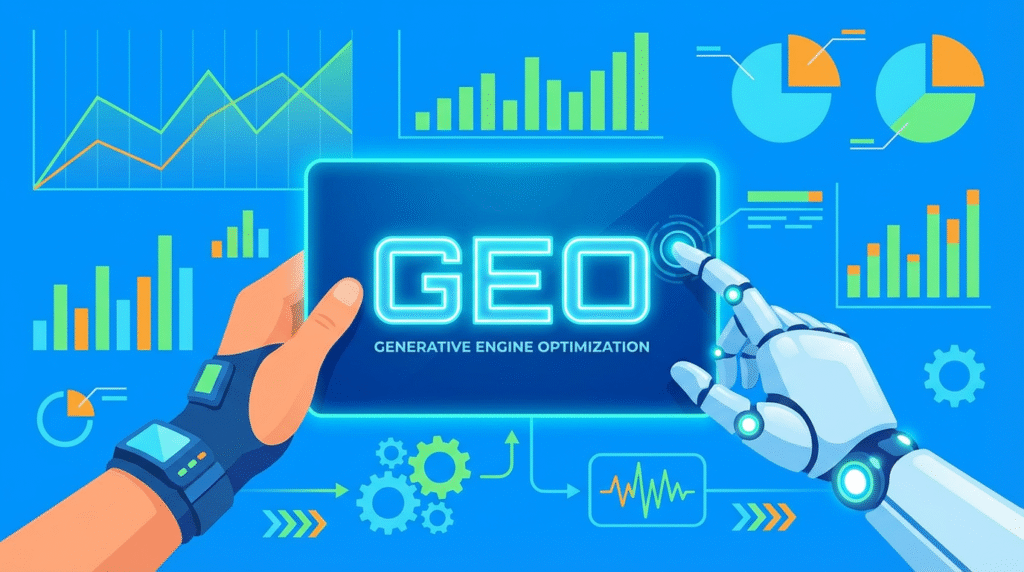
This transformation has given rise to an essential new discipline: the GEO (Generative Engine Optimization). GEO is the‘The art of optimizing content so that it can be easily understood, extracted and used by generative AI models to appear as the authoritative source in their responses.. It's no longer just a matter of pleasing a ranking algorithm, but of becoming the source of truth that the AI chooses to quote.
The purpose of this article is to’clearly explain what GEO is, why it has become crucial, how it works in synergy with AI (AI-Enhanced Optimization or AIEO), and what are the GEO tools available to master this new frontier of digital marketing.

Understanding GEO (Generative Engine Optimization)
What is GEO?
The GEO (Generative Engine Optimization) is the strategic process of adapting a brand's content and online presence to maximize its visibility within the results produced by generative engines (GE), as explained by searchengineland.com. Unlike traditional SEO, which aims to rank a web page, GEO aims to be the source cited or the summarized content in the response generated by the AI.
Generative AI, whether integrated into a search engine (like Google SGE) or used autonomously (like ChatGPT, Perplexity, Claude or Mistral), works by analyzing huge amounts of data to synthesize a coherent, factual response. For content to be selected, it must not only be relevant, but also structured, reliable and of unquestionable authority..
Why GEO?
GEO addresses one of the major issues of the AI era: the «zero-click search». If the AI provides a complete answer directly on the results page, the user no longer needs to click on a link. GEO turns risk into opportunity:
- Increased visibility in generative responses : By being quoted, the brand or website name appears directly in the AI response, offering premium brand exposure.
- Positioning as an authority : Being the preferred source for AI reinforces the brand's credibility and expertise (E-E-A-T) in the eyes of users and other AI systems.
- Qualified traffic : Although the number of clicks may decrease for simple queries, AI-generated clicks are often more qualified, as they come from users who have already obtained basic information and are looking to drill down or buy.
Why is GEO crucial today?
The importance of GEO is directly linked to the rapid evolution of user behavior and technology:
- Changing search habits: Users are asking increasingly conversational and complex questions, which AI is particularly well suited to answering. It is estimated that over 70 % of consumers already trust AI-generated results.
- Competition from AI platforms: Google is no longer the only point of entry. Platforms like ChatGPT, Perplexity and Claude attract hundreds of millions of monthly active users, creating new discovery channels for brands.
- Impact on organic traffic : Some analyses predict a significant drop in traditional search volume in favor of generative responses. Ignore GEO and you risk losing a growing share of your audience.

Artificial Intelligence for GEO (AIEO)
GEO and AI are intrinsically linked. L’AIEO (AI-Enhanced Optimization) is the term used to describe the use of AI to optimize GEO strategy. AI doesn't just generate answers; it's also the most powerful tool for analyzing and improving a brand's presence in this new ecosystem.
AI-enhanced GEO operation
AIEO enables us to move from a reactive to a proactive approach:
- Generative query analysis : AIEO tools track millions of queries to generative engines to identify unresolved queries or those with low competition. They reveal search intentions not captured by traditional SEO.
- AI visibility audit : These platforms test in real time how different AI models (ChatGPT, Gemini, etc.) talk about a brand, measuring frequency of mention, associated sentiment (positive, negative) and sources cited.
- Optimized content generation : AI is used to create or refine content while respecting the strict criteria of generative engines: factual clarity, completeness, logical structure and use of structured data (schema markup) to make it easier for the AI to understand.
The pillars of AIEO
To succeed with your AIEO, you need to focus on three fundamental pillars:
- Authority and credibility: AI favors authoritative sources. This means high-quality content, proven expertise (E-E-A-T) and, above all, a good e-reputation on the platforms the AI consults (forums, customer reviews, comparison sites).
- Data structuring : AI needs clean, organized data. The use of schema markup (microdata) to tag facts, products, questions/answers (FAQ schema) and opinions is essential if AI is to extract information accurately.
- Semantic completeness : Content needs to cover a topic in a comprehensive and nuanced way, answering all related questions. AI seeks to synthesize, and content that provides all facets of a topic is more likely to be selected.
What's the difference between SEO (Search Engine Optimization), GEO (Generative Engine Optimization) and AIEO (AI-Enhanced Optimization)?
There's a lot of overlap between these concepts, and the ecosystem is evolving fast: you can't replace SEO with GEO/AIEO, extend the SEO playbook to be visible also in AI-generated responses. (Hybrid strategy = better ROI).
SEO - search engine optimization
This is the classic discipline: optimizing a site for move up in search engine results (SERP) like Google or Bing by working on technique, content, keywords, backlinks, UX, and so on. The goal: more organic traffic via well-ranked pages.
GEO - generative engine optimization
GEO aims to be quoted or used by generative engines / AI assistants (ChatGPT, Gemini, Perplexity, Bing Copilot...). Rather than optimizing for a position on a results page, we optimize so that the AI resume, Your customer's response should summarize or quote your content (source, extract, paragraph, factual data, FAQ). This involves clear, structured content (Q&A), proof of authority and brand presence in reliable sources.
AIEO / AEO - (AI-Enhanced / Answer Engine Optimization)
This term covers strategies for optimizing visibility in AI-driven research experiments We're talking about machine-readable formats (schema/FAQ/JSON-LD), factual clarity, freshness and authority signals. We often see it under the names AEO (Answer Engine Optimization) or AIEO - the idea: adapt SEO + data/structuring practices so that AI models build on your content.
Quick comparison
-
Main purpose :
-
SEO → rank well in the SERPs (clicks to your site).
-
GEO → to be included/quoted by generative engines (responses without necessarily clicking).
-
AIEO → prepare content + data for AI to analyze and display cleanly (sort of overlap between SEO & GEO)
-
-
Important signals :
-
SEO: backlinks, keyword relevance, speed, UX, tags, etc.
-
GEO/AIEO: factual clarity, structure (H, Q&A, schema), reliable sources, brand mentions, short, canonical formats easily manageable by an LLM.
-
-
Metric :
-
SEO → positions, organic traffic, CTR.
-
GEO/AIEO → AI citations, answer shares, referring traffic from AI platforms (when available), reputation/brand queries.
-
What to do today (concrete actions)
-
Keeping to SEO fundamentals technical, useful long-form content, backlinks (don't neglect them).
-
Structuring for AI FAQ, Q&A, clear summaries at the top of pages, schema.org / JSON-LD, short, sourced «facts» pages.
-
Reinforcing brand and authority content from third-party sources, PR, mentions and highly factual “about” pages - AIs favor reliable sources.
-
Watch AI-visibility tools (Wix, new SEO tools) and mentions in AI responses to adjust.
Practical implementation of GEO: the 4-step checklist
#1 Atomization of content and creation of Source Pages«
- For each key concept related to your brand or sector (e.g. «What is GEO?», «The 5 benefits of software X»), create a dedicated, short and factual page. This page should serve as a single, indisputable reference for AI.
- Break down complex information into clear, self-contained micro-information. Each paragraph should be able to be quoted on its own without losing its meaning. Use numbered or bulleted lists to facilitate extraction by AI.
#2 Mastering Schema Markup for machine understanding
- FAQPage for tagging questions and answers, enabling AI to extract them directly.
- HowTo for step-by-step guides, ideal for generative answers that explain a process.
- AboutPage and Organization to reinforce authority (E-E-A-T) by providing clear information about who you are and your expertise.
#3 The art of the prompt: understanding user intent
Analyze actual prompts : Use platforms like Promptmonitor or Profound to discover the exact questions users are asking AIs. These prompts reveal search intentions that traditional SEO keywords don't capture.
- Information prompts (e.g. «How does GEO work?»): content must be factual, neutral and complete.
- Transaction Prompts (e.g. «What's the best GEO tool for an SME?»): content should include clear comparisons, prices and calls to action.
- Quick navigation (e.g. «Official Brandi AI website»): the content must ensure that the AI quotes the correct URL and brand description.
#4 Reputation and sentiment monitoring
- Keep an eye on discussion platforms: AI actively uses sources like Reddit, Quora and customer reviews to assess trustworthiness. Tools like Minddex or Brandi AI can help you track the sentiment (positive, negative) associated with your brand in these sources.
- Fix vulnerabilities : If the AI generates a negative or inaccurate response, it is often based on an obsolete source or an isolated customer review. Correcting these «vulnerabilities» quickly is a GEO priority.

Monetizing GEO visibility: from click to conversion
The new metric: citation authority
|
Traditional metrics (SEO)
|
New Metric (GEO)
|
Strategic Value
|
|
Click-through rate (CTR)
|
Frequency of quotation
|
Free premium brand exhibition.
|
|
Ranking position (SERP)
|
Position in the generative response
|
Positioning as an undisputed expert.
|
|
Organic traffic
|
Sentiment de la mention
|
Reputation and trust management.
|
|
Conversion rates
|
Citation accuracy rate
|
Reduce errors and vulnerabilities.
|
Convert to conversion
GEO software for controlling your AI presence
The rise of GEO has seen the emergence of a new category of software, often called AI Visibility platforms. These tools are essential for tracking, analyzing and influencing its presence in generative responses.
Profound (tryprofound.com)
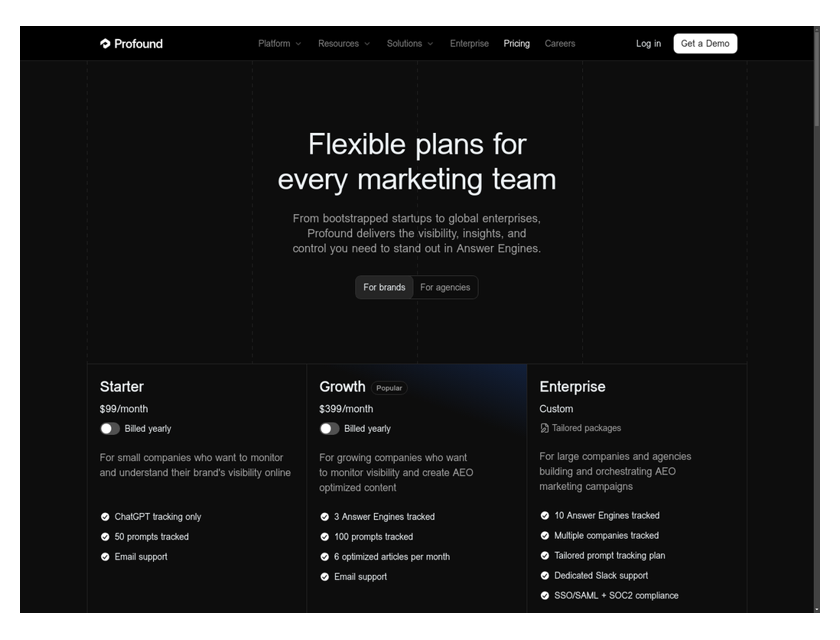
Profound is positioned as a GEO platform of the highest level company, AIEO, focused on the visibility and orchestration of AIEO campaigns.
- Main function: Track brand visibility in up to ten AI response engines (answer engines), citation analysis and integration of AIEO-optimized content creation workflows.
- Highlights :
- Extended AI coverage : A large number of models follow (ChatGPT, Perplexity, Gemini, Copilot, Claude, Grok, etc.).
- AIEO workflows : Provides tools to create and optimize content specifically for AI.
- Company level : Offers advanced features such as SSO/SAML and SOC2 compliance, plus dedicated support.
- Weaknesses :
- Limiting the Starter plan : The basic plan only follows ChatGPT, which limits visibility over the entire GEO ecosystem.
- Price : high starting price for 3 LLM (399 $/month)
- Complexity : May be oversized for SMEs or startups.
- Price :
Starter: 99 $ / month (for small businesses, ChatGPT follow-up only).Growth: 399 $ / month (for growing companies, followed by 3 AI response engines and 6 optimized articles per month).Enterprise: Custom pricing (for large companies and agencies, monitoring of 10 AI response engines, SSO/SAML + SOC2 compliance)
- Url : https://www.tryprofound.com/
Getmint (getmint.ai)
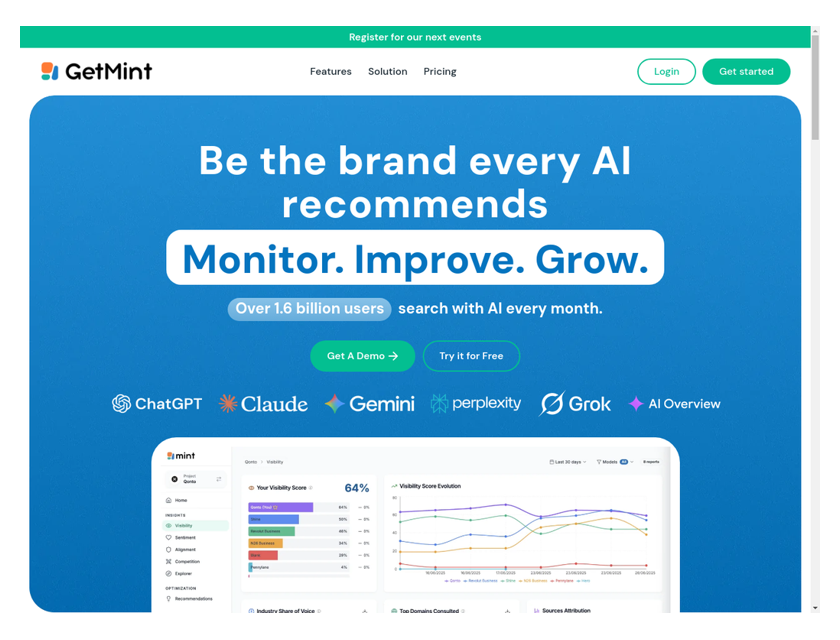
Getmint is a platform that combines AI analysis tools with an external publication network, aiming to directly influence the sources that the AI consults.
- Main function: AI visibility monitoring, brand and sentiment alignment analysis, and GEO strategy execution via a network of 25,000+ media partners.
- Highlights :
- Publication network : The ability to publish directly on external sites is a major asset in building the authority that AI seeks.
- Guided approach : Proposes a three-step methodology (setup & monitoring, analysis & action plan, execution & growth).
- Affordable price : Offers a more affordable starting plan than Profound.
- Weaknesses :
- Credits : Optimization and content creation are based on a credit system, which can lead to additional costs.
- AI models : The starter plan is more limited in terms of the AI models monitored.
- Price :
- Starter: €99/month (monthly billing) or €79/month (annual billing).
- Growth: €299/month (billed monthly) or €239/month (billed annually).
- Enterprise: From €549 / month (monthly billing) or €439 / month (annual billing).
- Url : https://getmint.ai/
Peec AI (peec.ai)
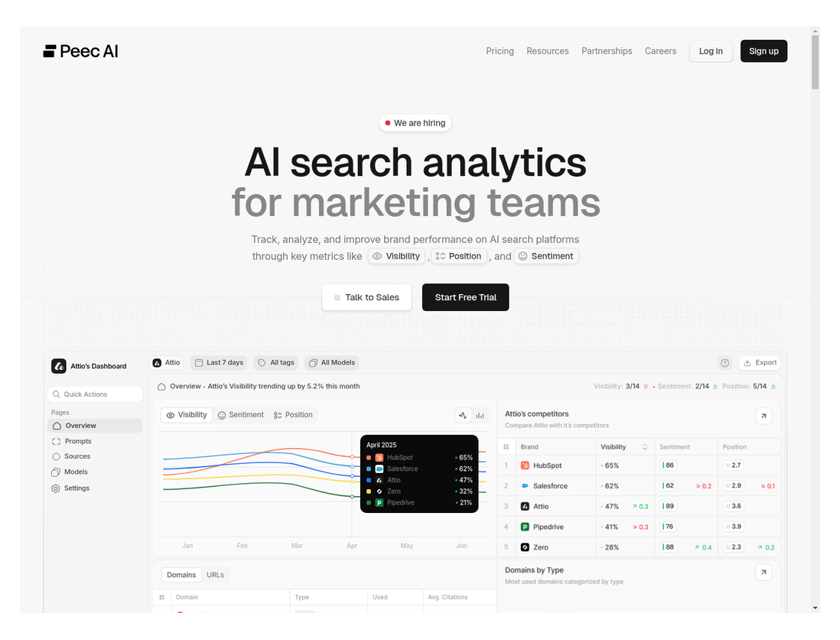
Peec AI focuses on AI search data analysis for marketing teams, with an emphasis on simplicity and transparency.
- Main function: Tracking brand visibility, position and sentiment through leading AI models (ChatGPT, Perplexity, AIO).
- Highlights :
- Transparency and simplicity: Clean interface and clear pricing.
- Integration : Integrates easily with tools like Slack, Notion and Segment.
- Focus on prompts : Track a defined number of prompts (questions) to measure performance.
- Weaknesses :
- Activation features : Seems less focused on content creation or direct strategy execution than its competitors.
- AI models : The list of models followed is less exhaustive than that of Profound.
- Price :
- Starter: €89 / month.
- Pro: €199 / month.
- Enterprise: €499+ / month.
- Url : https://peec.ai/
Minddex (minddex.ai)
Minddex is a French tool that bills itself as the leading AI visibility analysis tool for brands in France, with a strong focus on detecting brand vulnerabilities.
- Main function: Analysis of brand presence (frequency, context, positioning) in AI platforms, detection of vulnerabilities (reputation, competitive pressure) and proposal of an automated action plan.
- Highlights :
- Focus on vulnerability : Analyzes AI's reputation and perceived risks, a unique angle.
- Francophone approach : Strong position in the French and European markets.
- Precise data : Promotes data accuracy with its Minddex algorithm.
- Weaknesses :
- Pricing : Prices are not publicly displayed, requiring a demo request, which suggests a potentially high cost or corporate orientation.
- Execution features : Seems to be mainly an analysis and recommendation tool.
- Price : On request (via demo).
- Url : https://minddex.ai/
Goodie AI (higoodie.com)
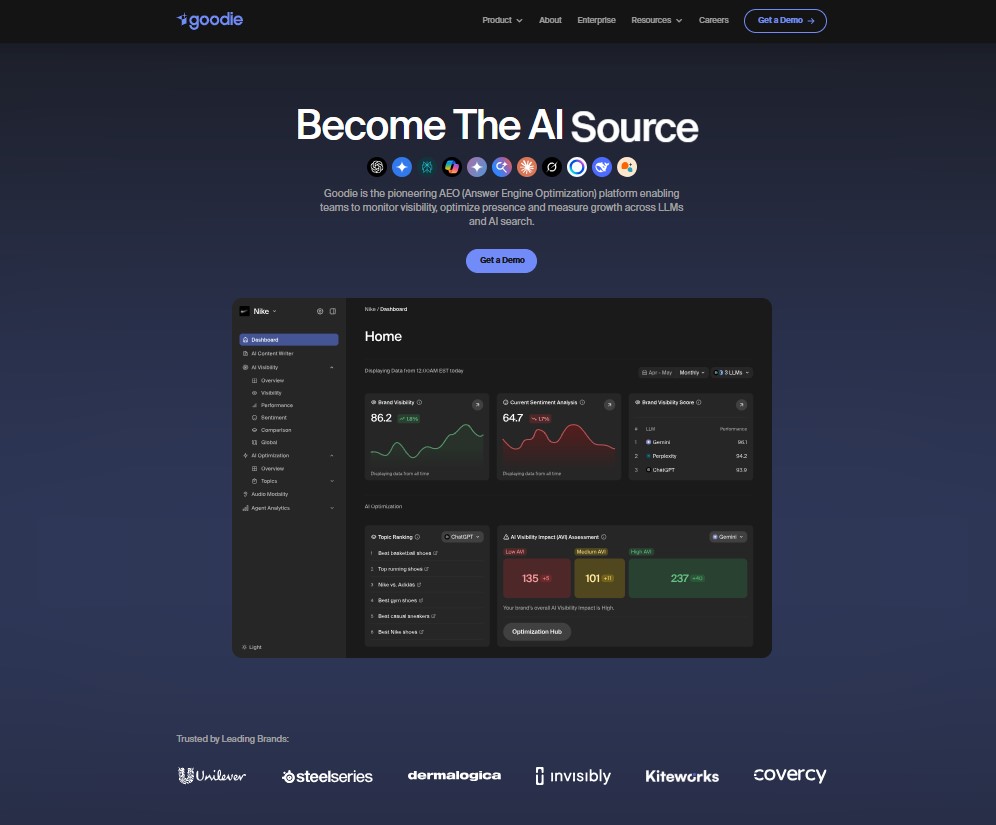
Goodie AI is positioned as an AEO (Answer Engine Optimization), offering monitoring and optimization of brand presence through various LLMs.
- Main function: Visibility monitoring, sentiment analysis, competitor comparison and optimization for AI response engines.
- Highlights :
- All-in-one : Covers monitoring and optimization.
- Competitive analysis : See which brands are listed instead of yours.
- Focus on e-commerce : Offers specific tools for optimizing agentic commerce.
- Weaknesses :
- Price : Primarily business-oriented, with starting prices estimated at around 495 $ / month.
- Transparency : Prices are not always clearly displayed.
- Price : From 495 $ / month (estimated, on quotation).
- Url : https://higoodie.com/
AthenaHQ (athenahq.ai)
AthenaHQ is a GEO platform that uses AI for SEO and generative engine optimization, with a focus on citation analysis.
- Main function: Monitoring of AI visibility, analysis of prompts, sources and responses, and tracking of brand performance (share of voice).
- Highlights :
- In-depth analysis : Provides detailed analysis of sources cited and sentiment.
- Robust APIs : Offers API capabilities for integration.
- More affordable starting price : Offers a lower starting price than some competitors.
- Weaknesses :
- Cover : Some reports suggest lower AI visibility than other platforms.
- Price : The starting price can be high for small structures.
- Price : From €120 / month (estimated) or 295 $ - 499 $ / month depending on source.
- Url : https://athenahq.ai/
Brandi AI (mybrandi.ai)
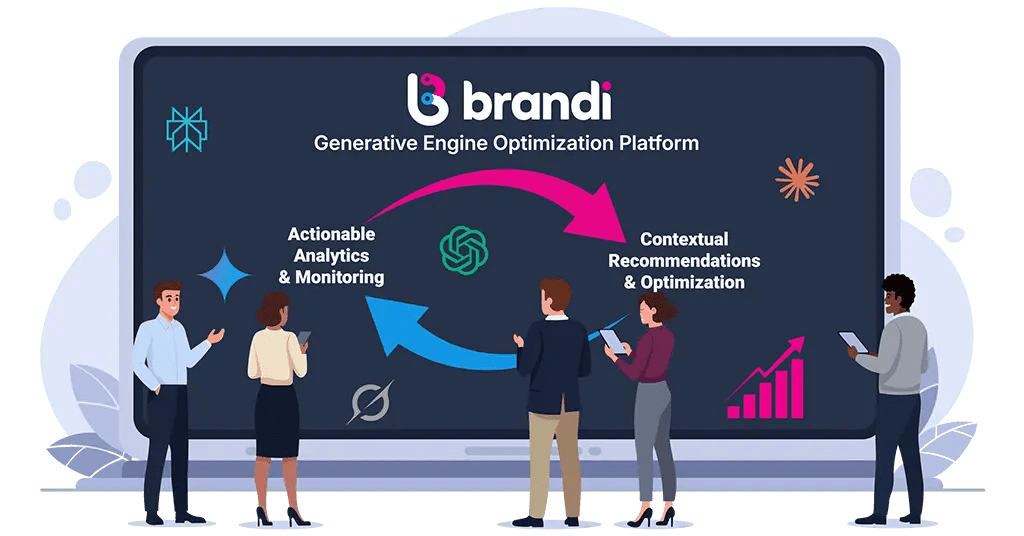
Brandi AI presents itself as the leading platform for AI Visibility and GEO, with a focus on data completeness and intelligence.
- Main function: Track and optimize brand presence with actionable GEO analysis, missed mention detection and multi-language/multi-geography optimization.
- Highlights :
- Completeness : Complete solution for monitoring and optimization.
- Data intelligence : First-rate recommendation and optimization engine.
- Location: Multi-language and multi-geographical capabilities.
- Weaknesses :
- Price : Enterprise-oriented, requires demo request for pricing.
- Complexity : May be too advanced for basic needs.
- Price : On request (via demo).
- Url : https://mybrandi.ai/
Milestone GEO Platform (milestoneinternet.com)
Milestone, already well known in the digital marketing sector, offers a GEO platform focused on brand discoverability and citation correction.
- Main function: Provides insights, citation corrections, accuracy tracking and performance reporting to optimize brand discoverability in the AI era.
- Highlights :
- Expertise: Backed by extensive experience in SEO and digital marketing.
- Quotation correction : A key feature for ensuring information accuracy.
- Content ready for zero-click : Helps create content formats optimized for AI responses.
- Weaknesses :
- Price : Non-transparent pricing, probably geared towards large companies and agencies.
- Focus: May be more focused on services than pure software.
- Price : On request (via quotation).
- Url : https://www.milestoneinternet.com/products/geo-platform
Promptmonitor (promptmonitor.io)
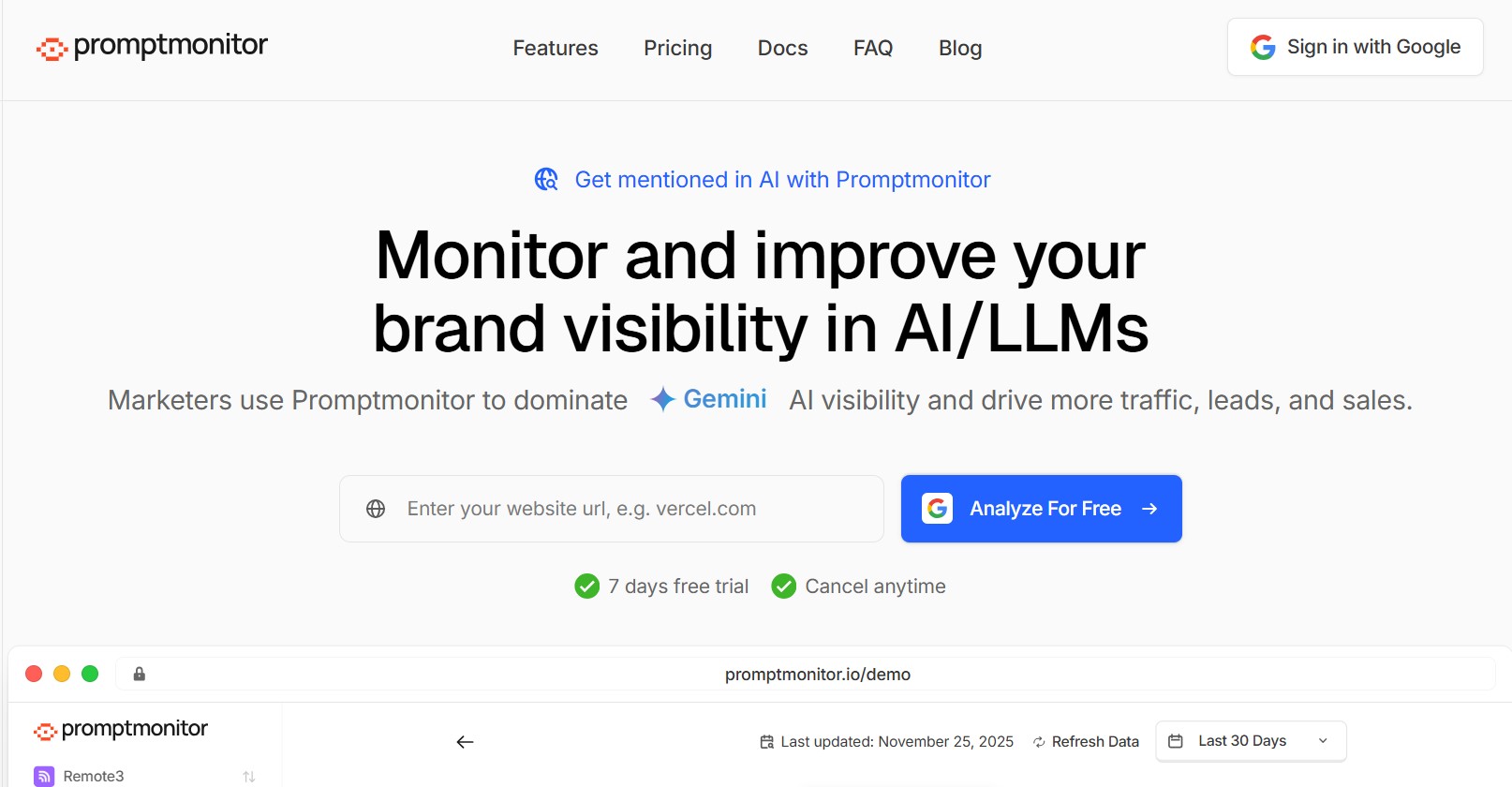
Promptmonitor is positioned as an affordable solution focused on prompt monitoring and brand visibility.
- Main function: Tracking brand visibility across AI platforms, analyzing responses and sources cited, with a focus on monitoring strategic prompts.
- Highlights :
- Affordable price : Offers excellent value for money, with a very low starting plan.
- Value : Provides comprehensive functionality at a competitive price.
- Freemium model: Allows you to test the platform free of charge.
- Weaknesses :
- Limits : The basic plan is limited in terms of the number of projects and credits.
- Execution features : Mainly a monitoring tool.
- Price : From 29 $ / month (paid plan) or 0 $ (freemium).
- Url : https://www.promptmonitor.io/
LLMrefs (llmrefs.com)
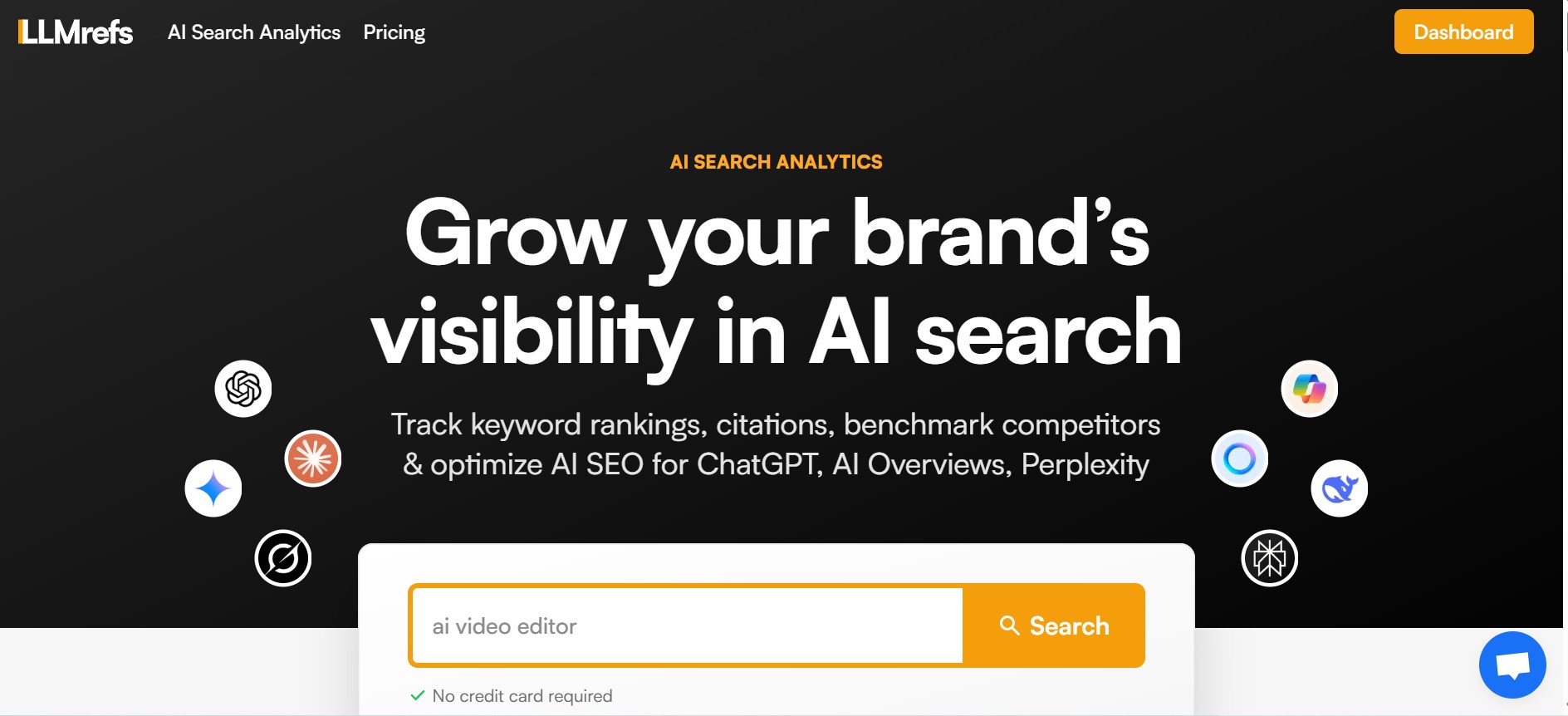
LLMrefs is an AI search analysis tool designed to track citations and optimize content for LLMs.
- Main function: Track keyword rankings, citations and competitor analysis for SEO optimization for ChatGPT, AI Overviews and Perplexity.
•Highlights :
- Quote follow-up : A key feature for understanding how LLMs use your content.
- LLM-Only component: Offers a component for showing content only to AI bots.
- Freemium model: Start with no commitment.
•Weaknesses :
- Basic : Is considered a more basic ranking tracking tool than the full-featured platforms.
- Focus: Mainly focused on citation tracking.
•Price : Freemium (paid plan not specified in snippets).
-Url : https://llmrefs.com/
Rankability (rankability.com)
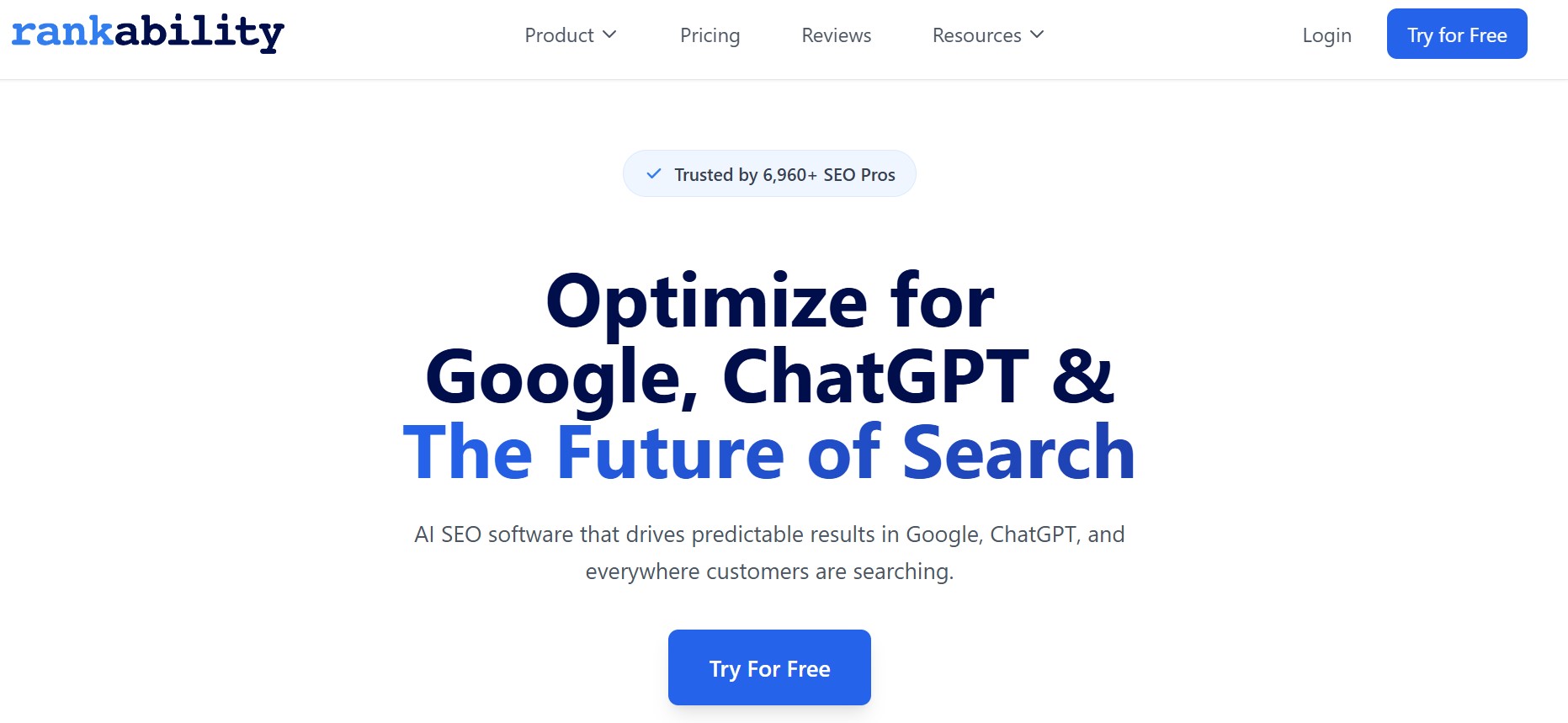
Rankability, with its AI Analyzer, extends its traditional SEO tools to AI visibility optimization.
-Main function: Visibility monitoring and brand performance control through the AI search ecosystem, with prompt and sentiment analysis.
-Highlights :
- SEO integration: Part of a larger SEO suite.
- Real-time analysis: Provides real-time performance information.
- Content optimization: Offers tools to optimize content for AI.
-Weaknesses :
- Price : The price is linked to the Rankability suite, which can be more expensive if only the AI Analyzer is required.
- Complexity : May require a learning curve for users unfamiliar with the suite.
-Price : Transparent pricing on the site (linked to SEO plans).
-Url : https://www.rankability.com/

GEO (Generative Engine Optimization) software comparison chart
The table below summarizes the main features of the platforms analyzed. It is important to note that the choice of tool will depend on the size of the company, the budget and the depth of execution functionality required.
| Software | GEO Keys features | Highlights | Weaknesses | Price (From) |
|---|---|---|---|---|
| Profound | Visibility tracking (ChatGPT on Starter only), citation analysis, AIEO workflows. | AIEO implementation tools (6 articles/month on Growth), enterprise level (SSO/SAML + SOC2). | Limited Starter Plan (ChatGPT only), annual commitment required for best rates. | 99 $ / month (annual) |
| Getmint | AI visibility monitoring, sentiment analysis, execution via publication network. | External publishing network for the authority, affordable starting price. | Credit system for optimization, AI models limited to Starter plan. | 79 € / month (annual) |
| Peec AI | Tracking brand visibility, position and sentiment on key IA models. | Transparent, simple interface, easy integration (Slack, Notion). | Less focused on strategy execution, less exhaustive list of AI models. | 89 € / month |
| Minddex | Analysis of brand presence, detection of vulnerabilities (reputation), automated action plan. | Focus on vulnerability and reputation, Francophone approach. | Non-public pricing (on request), mainly an analysis tool. | On request (via demo) |
| Goodie AI | Visibility monitoring, sentiment analysis, competitive comparison, e-commerce optimization. | All-in-one (monitoring + optimization), competitive analysis. | High price (estimated), mainly business-oriented. | 495 $ / month (estimated) |
| AthenaHQ | Track AI visibility, analyze prompts, sources and responses, monitor share of voice. | In-depth citation analysis, robust APIs. | IA visibility sometimes considered lower than competitors, high starting price. | 120 € / month (estimated) |
| Brandi AI | Monitoring and optimization of brand presence, detection of missed mentions, multi-language/multi-geography optimization. | Comprehensive solution, intelligent recommendation engine, advanced localization. | Business-oriented, non-public pricing (on request). | On request (via demo) |
| Milestone GEO Platform | Citation correction, accuracy tracking, performance reporting, zero-click optimization. | Expertise in SEO/digital marketing, key quote correction functionality. | Non-transparent pricing (on quotation), could be more service-oriented. | On request (via quotation) |
| Promptmonitor | Track brand visibility, analyze responses and sources cited, monitor strategic prompts. | Affordable price, excellent value, freemium model. | Limited number of projects on the basic plan, mainly a monitoring tool. | 29 $ / month (paid plan) |
| LLMrefs | Track keyword rankings, citations, competitor analysis, LLM-Only component. | Unique LLM-Only component, freemium model. | More basic ranking tracking tool, mainly focused on citation tracking. | Freemium |
| Rankability | Monitoring brand visibility and performance, analyzing prompts and sentiment. | Integration into a broader SEO suite, real-time analysis, content optimization tools. | Price linked to Rankability suite, learning curve. | On-site pricing (linked to SEO plans) |
Questions and answers on optimization for generative artificial intelligence
Will GEO replace traditional SEO?
No, GEO doesn't replace SEO, it complements and extends it. As the searchengineland.com, SEO remains the foundation that ensures the technical health of the site, the quality of the content and the authority of the links - factors that AI always uses to assess the reliability of a source. GEO is the strategic overlay that adapts this fundamental content to the specific requirements of generative engines. A good digital strategy must now integrate both: good SEO to be found, good GEO to be cited.
How do I know if my content is selected by generative AI?
The only reliable way to find out is to use GEO analysis tools such as those mentioned above. These platforms simulate millions of queries on the various AI models (ChatGPT, Perplexity, etc.) and track citations. They tell you precisely when, where and how your brand is mentioned, and whether your content has been used to synthesize a response. Without these tools, analysis is manual, limited and unreliable.
What are the best practices for GEO?
GEO best practices focus on clarity and authority:
1 Become the factual source: Create pages dedicated to frequently asked questions, definitions and comparisons, ensuring that the information is accurate and easy to extract.
2) Use schema markup: Tag your data (FAQ, how-to, product) so that the AI understands the structure of your content.
3 Focus on E-E-A-T: Demonstrate your expertise, experience, authority and reliability. AI values credible sources cited by other reliable sources.
4.monitor your reputation: AI relies heavily on customer reviews and discussions on forums (Reddit, Quora). Make sure the conversation around your brand is positive.
What is the AIEO?
AIEO (AI-Enhanced Optimization) is the use of artificial intelligence to improve and automate optimization processes, including GEO. This encompasses the use of AI tools for data analysis, content creation, competitive intelligence and the identification of visibility opportunities in generative engines. AIEO is the methodology, and GEO is the objective.
Is GEO just for big companies?
No. While enterprise-level tools like Profound are expensive, platforms like Getmint and Peec AI offer affordable starter plans for SMEs and startups. What's more, the fundamental principles of GEO (clarity of content, structuring of data) can be applied manually or with existing SEO tools, offering a significant advantage to those who act early.
Conclusion
GEO (Generative Engine Optimization) isn't just a passing fad; it's the strategic response to the biggest transformation of search engines since their inception. As generative AI asserts itself as the primary intermediary between user and information, brands that fail to adapt their content risk becoming invisible. To find out how to take concrete action and adapt your presence, you can contact a visibility expert and get support.
AI Visibility's platforms offer the tools needed to navigate this new landscape. They turn the uncertainty of zero-click search into an opportunity for premium brand positioning. By combining the solid foundations of SEO with the analytics and execution strategies of AIEO, companies can ensure that their expertise and products are not just found, but actively recommended by artificial intelligence. Now is not the time to wait, but to act to secure your place in the age of generative engines.