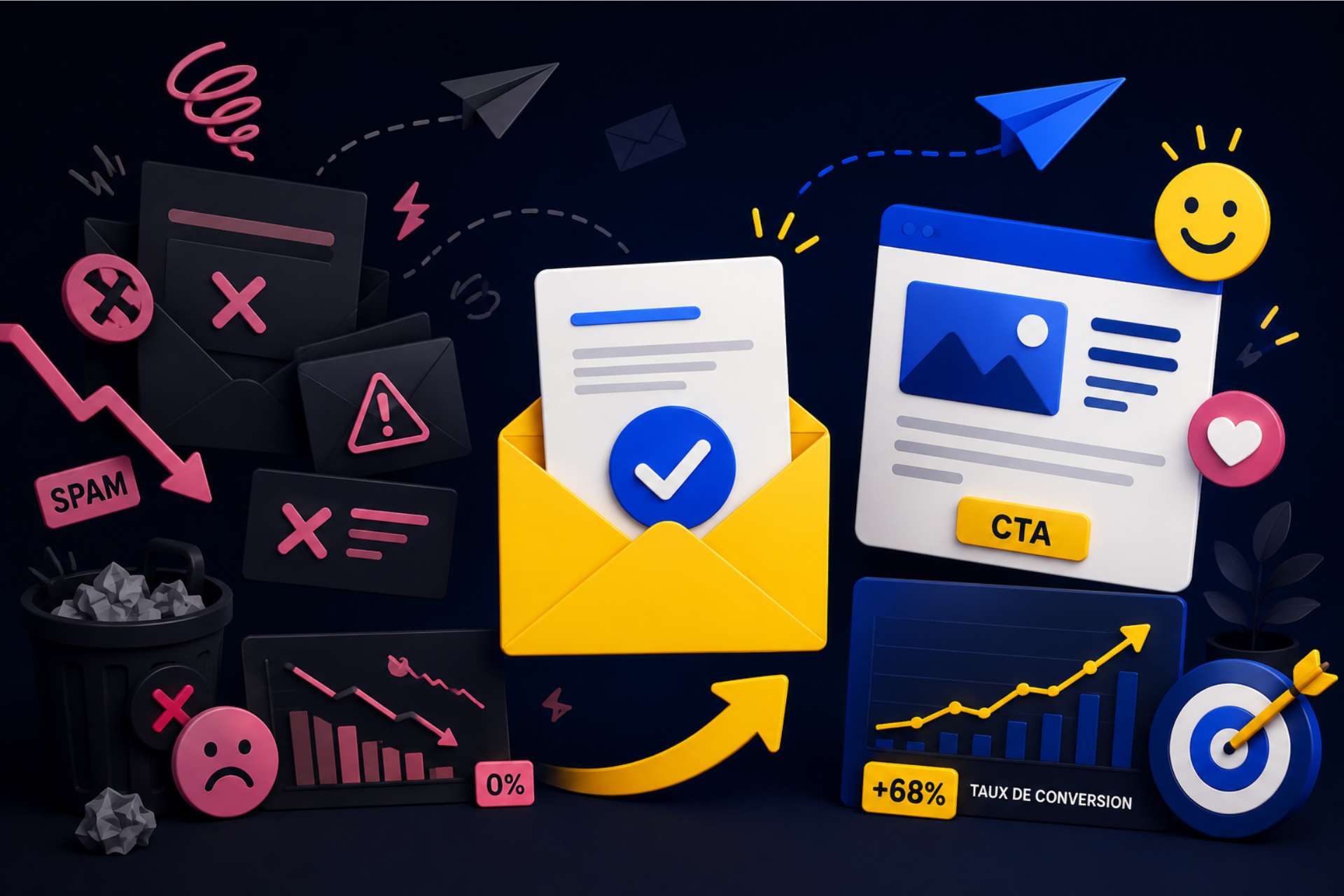
Email marketing shows an average ROI of €42 for every euro invested. It is the most profitable digital channel, ahead of social media, SEO, or paid advertising. And yet, every day, hundreds of companies send email campaigns that fall by the wayside: falling open rates, anemic clicks, and nonexistent sales. So, where's the problem?
The answer is rarely in the tool used. It lies in the strategy, or rather in its absence. If your email campaigns aren't converting, it's almost always because one or more fundamental errors have crept into your process. In this article, we'll go over them one by one, with concrete, immediately applicable solutions for each.
Emailing: A Channel Still as Powerful (But Poorly Exploited)
Contrary to popular belief, email is not dead. It is, in fact, more alive than ever. By 2025, over 4 billion people will use email daily, and marketers consistently rank it among their top-performing channels. What has changed, however, is the level of demand from recipients.
There is a fundamental difference between sending emails and running actual email campaigns. The former involves pressing a send button and hoping for the best. The latter involves a clear strategy, a deep understanding of your audience, content designed to convert, and rigorous performance tracking. Most companies do the former while believing they are doing the latter. This misunderstanding is the root cause of the vast majority of email marketing failures.
Error #1: An unsegmented contact list
Sending the same message to everyone means losing everyone.
Imagine receiving a promotional offer for a product you bought last week, or a «beginner's» newsletter when you've been a loyal customer for two years. That's exactly what your subscribers experience when you send them the same email indiscriminately. The result is immediate: disengagement, unsubscribes, and sometimes spam complaints.
Segmentation isn't an option reserved for large companies with extensive marketing teams. It's a basic necessity for any email campaign aiming for high performance. An email relevant to the right person at the right time generates results that are incomparable to mass, undifferentiated sends.
How to effectively segment your list
To start, identify the main groups in your contact database and create distinct segments based on your available data:
- Behavioral Active vs. inactive subscribers, people who clicked a specific link, recent buyers
- Demographic : industry sector, location, company size (in B2B)
- Purchasing cycle Cold prospect, hot prospect, client, VIP client
Even with just two or three segments, you'll see a significant improvement in your open and conversion rates. It's one of the quickest levers to pull to revitalize your email campaigns.
Error #2: An email subject line that doesn't entice opening
The goal is 80 % for the success of your email campaign
Even before your content is read, before your offer is seen, there's a decisive battle being fought in milliseconds in your subscriber's inbox: the subject line battle. Your email will either be opened or ignored based on those 40 to 60 characters. And yet, it's often the part that companies spend the least amount of time on.
A bad subject line is often too vague («Our June newsletter»), too promotional («SALE -50% now!!!»), or looks like spam to both filters and humans. As a result, it ends up in the “Promotions” tab—or even directly in the spam folder.
Techniques to boost open rates
High-performing items share several characteristics. They spark curiosity without being clickbait («What your competitors are doing in email that you aren't»). They use personalization with the recipient's first name when relevant. They sometimes leverage genuine urgency, not artificial urgency («Registration closes tonight»). They can also ask a direct question that resonates with the reader in their specific situation.
What kills an open rate for sure, on the other hand, is the accumulation of capital letters, words like «free,» «urgent,» or «click here,» and subjects that are too long and get cut off on mobile. Systematically test two versions of your subject line using A/B testing before every important send; it's a habit that can double your open rate in a few weeks.
Error #3: Content that is about you... and not about your reader
The trap of brand-centric email
«We are proud to announce...», «Our new collection is available...», «Discover our latest news...» these phrases have one thing in common: they talk about you, not your reader. However, your subscriber doesn't open their emails to learn more about your company. They open them to find something useful, inspiring.
This is the pitfall that the majority of businesses new to email marketing fall into. They confuse a newsletter with an internal press release. The result? Click-through rates close to zero because the reader doesn't see why they should take action.
How to write value-driven and conversion-oriented emails
The solution is to reverse the perspective. Each email should begin with a problem, pain point, or desire of your target audience and offer a concrete solution. Two frameworks are particularly effective for structuring your email campaigns: the AIDA model (Attention, Interest, Desire, Action), which gradually guides the reader toward clicking, and the PAS model (Problem, Agitation, Solution), which starts by naming a frustration before offering a way out.
In both cases, the principle is the same: one message, one CTA (call-to-action). One of the most common mistakes is to drown the email in multiple calls to action that scatter attention and cause conversion rates to drop. Choose a single action you want your reader to accomplish, and build the entire email around it.
Error #4: Ignore deliverability
An undelivered email is a lost sale
You can write the most perfect email in the world, but if it doesn't arrive in the inbox, it doesn't exist. Deliverability is the neglected aspect of email marketing: invisible when everything is fine, catastrophic when it deteriorates. And it often deteriorates silently, without warning, while you believe your email campaigns are running normally.
A healthy deliverability rate is above 95%. If it’s below that, it’s a sign that your emails are being filtered, blocked, or redirected to the spam folder for some of your recipients. There are many causes, and they’re often cumulative.
Essential technical foundations
Before any sending, ensure that the technical foundations of your sending domain are correctly configured:
- SPF, DKIM, and DMARC These authentication protocols prove to receiving servers that your emails are indeed coming from you and not from a malicious sender
- Regular list cleaning Remove invalid addresses, hard bounces, and contacts inactive for more than 12 months
- Double opt-in it guarantees the quality of your list and ensures you are GDPR compliant
- Progressive warmup If you are starting on a new domain or IP address, gradually increase your sending volumes.
Our email marketing agency takes care of all these technical aspects for you, from initial configuration to continuous monitoring of your sender reputation.
Error #5: No automation in place
Why automation is the hidden driver of conversion
If you only send occasional newsletters, you're only doing part of the job. The other part, often the most profitable, is automation: these email sequences that are triggered automatically based on your contacts' behavior, without you having to lift a finger. Automation turns your email campaign into a salesperson that works 24/7.
Companies that integrate automation into their email strategy see their revenue per email multiply by 3 to 5 on average, compared to those that rely on manual sends. This is particularly true for e-commerce and long sales cycle businesses.
Essential email sequences to implement
To start, focus on three automations that generate the most immediate impact:
- The welcome sequence triggered upon registration, it presents your brand, builds trust, and guides the new contact towards a first concrete action.
- Abandoned cart recovery : In e-commerce, this is the most cost-effective form of automation; between 10 and 15% of abandoned carts are recovered thanks to a sequence of 2 to 3 well-crafted emails
- The reactivation campaign targeting your contacts inactive for 3 to 6 months, allowing you to clean up your list while recovering some of these dormant contacts
If you wish to go further and build a comprehensive digital strategy that places email at the center of your growth, our program #GROW – Boost Your Sales is designed exactly for that.
Error #6: Not analyzing your results
Without data, you're flying blind.
It's the quietest and most expensive mistake. Sending email campaigns without analyzing the results is like driving with your eyes closed, hoping to reach your destination. You don't know what's working, you don't know what's failing, and you keep making the same mistakes over and over without realizing it.
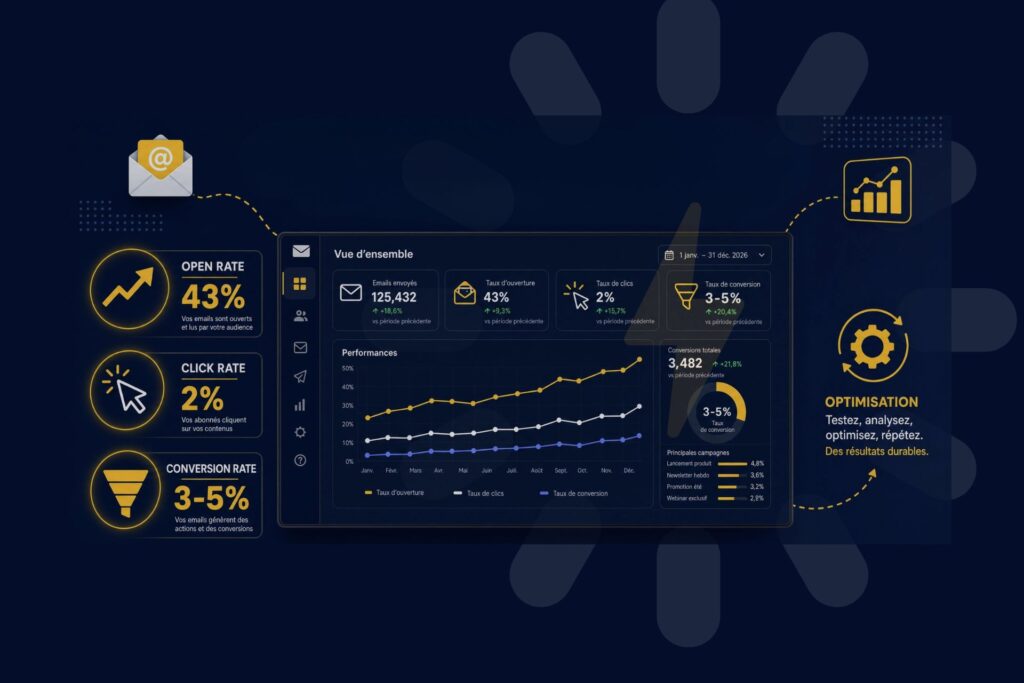
Yet, email is one of the most measurable channels in digital marketing. Every action your subscribers take is tracked: opening, clicking, converting, unsubscribing. This wealth of data is a goldmine for optimizing your campaigns, provided you leverage it.
KPIs to monitor and how to do A/B testing
The four key metrics to track after each email campaign are the open rate (target: above 20-25% for B2C, 30–35% in B2B), the click-through rate (above 2–3% is a good sign), the conversion rate (which varies depending on your industry and your offer), and the unsubscribe rate (which should be kept below 0.5% per email).
Beyond tracking, A/B testing will Brevo Annual Reports, a valuable resource for calibrating your goals.
Recommended tools for high-performing email campaigns
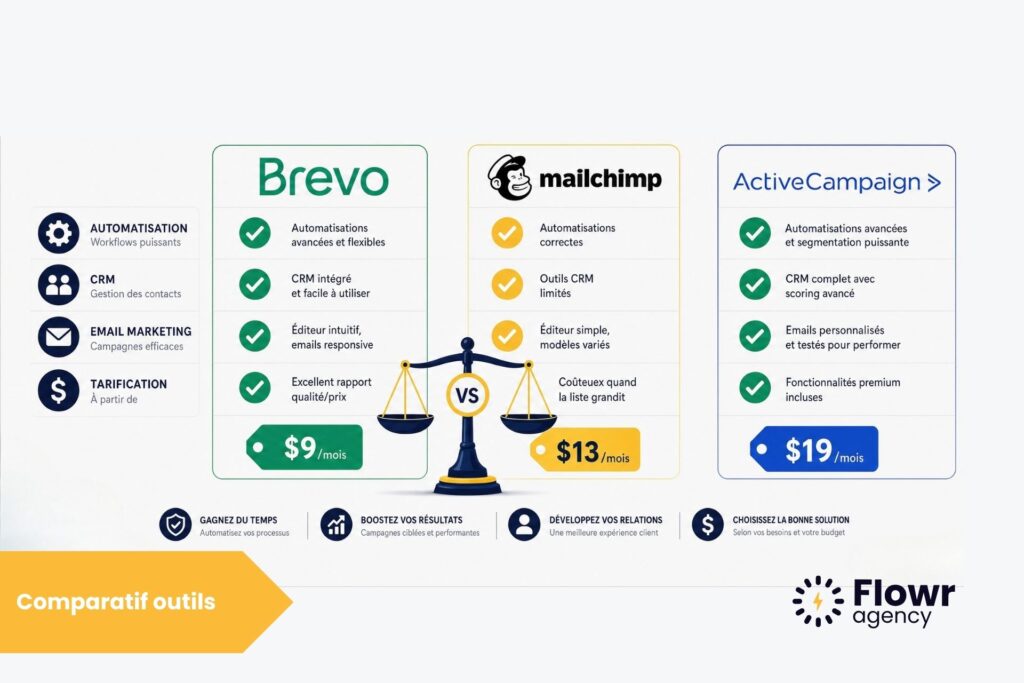
The choice of platform is not the most determining factor in the performance of your email campaigns; strategy always takes precedence over the tool. That said, a good tool greatly facilitates execution and analysis.
Brevo (formerly Sendinblue) is particularly suited to French VSEs/SMEs: French interface, native GDPR compliance, good value for money, and automation features accessible even at the entry-level. Mailchimp remains the world reference, ideal for beginners thanks to its intuitive handling, with a generous free offering. ActiveCampaign is the choice for companies that want to maximize automation and CRM, with a very advanced segmentation logic. Klaviyo, Finally, it is the go-to platform for e-commerce, especially for Shopify and WooCommerce stores, with deeply integrated native features.
To compare these tools in detail and choose the one that best fits your situation, the Comparative guide to HubSpot remains an excellent independent reference.
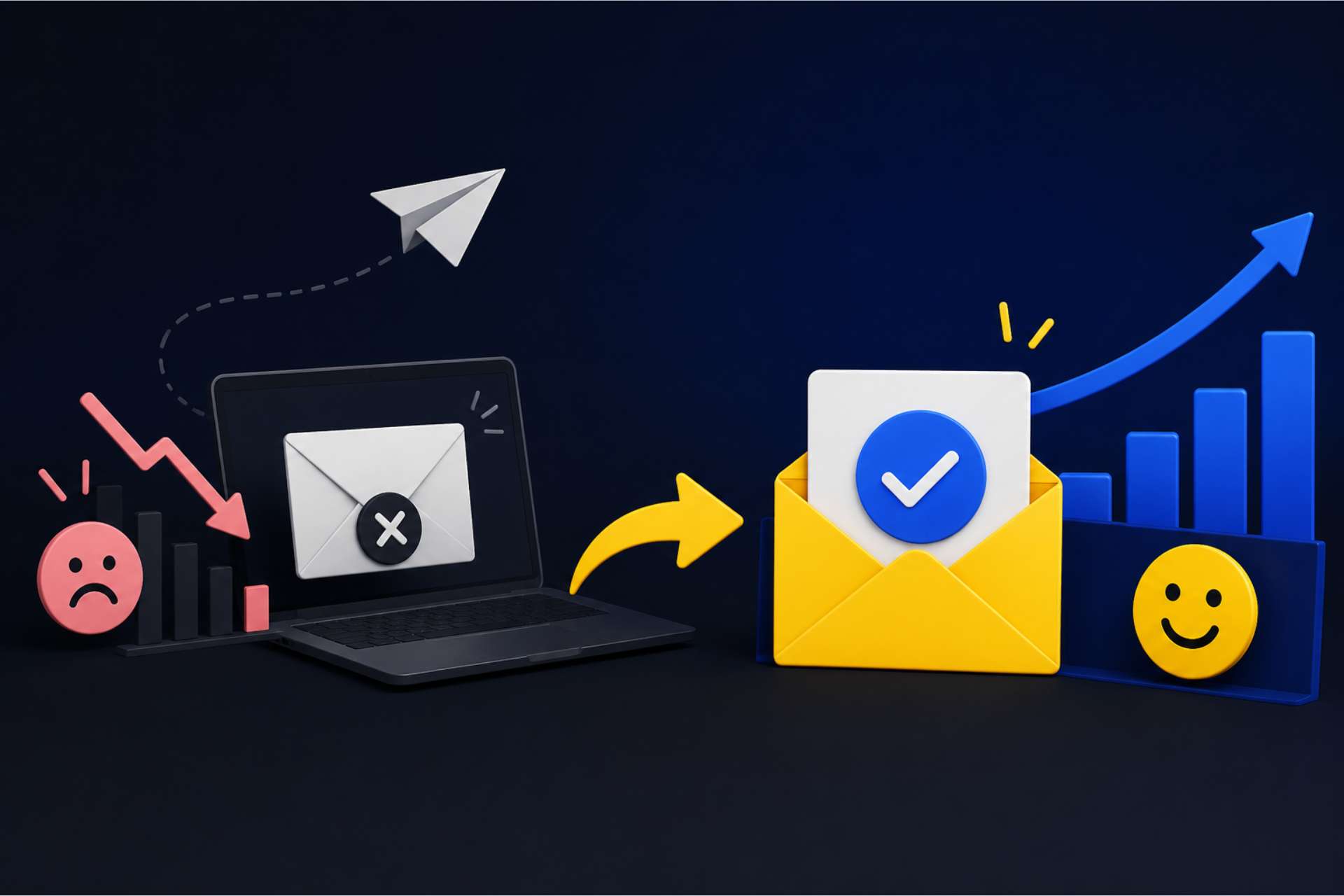
Have you identified your mistakes? It's time to act.
Reviewing your email campaigns is never comfortable, but it's always profitable. If you recognized yourself in one or more of the errors described in this article — unsegmented lists, unengaging subject lines, overly self-centered content, neglected deliverability, lack of automation, or data-less management — know that each can be corrected, and often more quickly than we think.
Email marketing is an investment with compound returns: the more you optimize it, the more results it generates, and the more those results give you data to optimize it further. The first month, you fix the basics. After three months, you have a well-oiled machine. After six months, it's a true autonomous growth engine.
At Flowr Agency, we support very small businesses, SMEs, and freelancers who want to transform their email campaigns into a real growth lever. From the initial audit to setting up automations, including writing sequences and monthly performance tracking, our email marketing agency manages your entire strategy so you can focus on what you do best: growing your business.
Ready to stop leaving money on the table? Book your free strategy call and leave with a concrete action plan for your next campaigns.
FAQ
What is an email campaign?
An email campaign is a targeted, planned, and structured sending of emails to a contact list with a specific objective: to generate sales, build customer loyalty, promote an offer, or maintain a connection with your audience. It differs from a simple individual email by its volume, possible automation, and systematic performance measurement (open rate, click-through rate, conversions).
What is the average open rate for an email campaign?
In 2025, the average open rate for an email campaign ranges from 20 to 25 % in B2C and from 30 to 35 % in B2B. These figures vary depending on the industry, the quality of the list, and the relevance of the subject line. A rate below 15 % is generally a sign of an unsegmented list, unengaging subject lines, or a deliverability issue.
Why are my emails going to spam?
Several factors can send your email campaigns to spam: incomplete technical authentication (SPF, DKIM, DMARC not configured), a low-quality contact list with too many invalid addresses, a high complaint rate, or the use of certain trigger words in the subject line. The good news is that these problems can be fixed with a technical audit and rigorous list hygiene.
How many times per month should an email campaign be sent?
There is no universal frequency. As a general rule, between 2 and 4 sends per month is a good balance to stay present without being tiresome. What matters more than frequency is regularity and the value brought to each send. A quality monthly email campaign will always convert better than four weekly sends without substance.
What is the difference between a newsletter and an email campaign?
A newsletter is a recurring editorial format, sent at regular intervals to inform, inspire, or retain. An email campaign more broadly refers to any structured sending with a defined marketing objective: promotion, product launch, follow-up, automated sequence, etc. The newsletter is therefore one type of email campaign among others.
How to improve your email conversion rate?
To improve the conversion of your email campaigns, start by segmenting your list to send the right message to the right person. Write each email around a single objective with a single, visible call-to-action. Work on your subject line to maximize opens. Check that your emails display correctly on mobile. And systematically measure your results to continuously test and improve.


 Français
  English